Loading episode...
EP.77
Sep 8, 202600:32:17Season 1
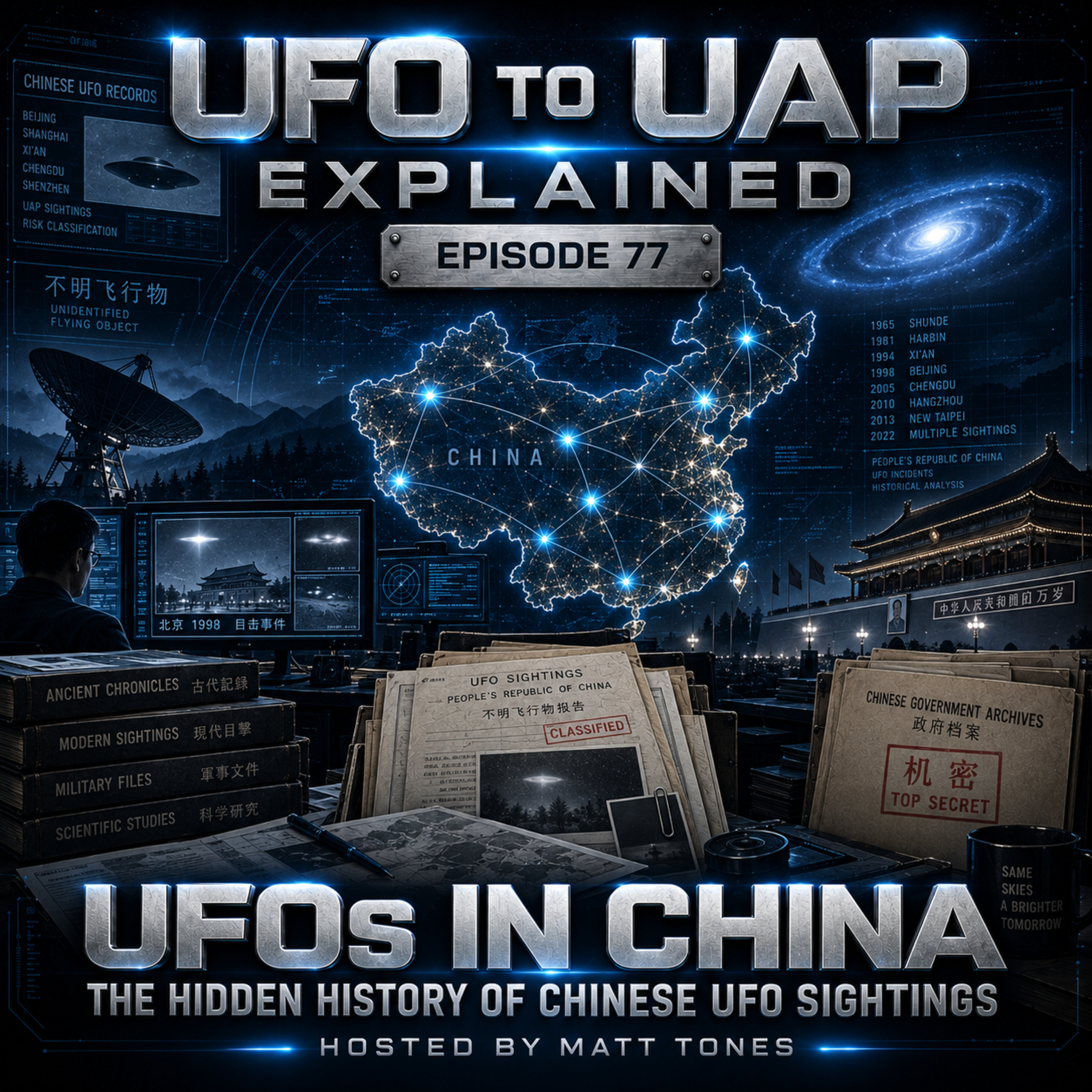
UFOs in China: The Hidden History of Chinese UAP Sightings
0:00 / 0:00
// Show Notes
China’s UFO history is far older, broader and more complicated than most Western accounts suggest. In Episode 77 of UFO to UAP Explained, Matt Tones investigates the hidden history of UFO sightings in China, from ancient astronomical records and Chinese newspaper coverage of the 1947 flying-saucer wave to the extraordinary UFO boom that followed the People’s Daily article “UFO — An Unresolved World Mystery” in November 1978.
We trace the creation of China’s first major civilian UFO research organisation at Wuhan University, the nationwide 24 July 1981 luminous spiral sighting, the mysterious 1994 Guiyang “Flying Train” incident, and the 2010 unidentified object that temporarily shut down Hangzhou Xiaoshan International Airport. The story then moves inside modern Chinese air defence. This episode separates documented Chinese UFO history from speculation about extraterrestrial technology and asks why China may represent one of the biggest missing datasets in the global UAP mystery.
Keywords:
UFOs in China, Chinese UFO sightings, China UFO history, China UAP, Chinese UAP, UFO sightings China, China UFO files, Chinese UFO research, China UFO Research Association, Wuhan UFO research, 1981 China UFO, China spiral UFO, Guiyang UFO, Flying Train UFO China, Hangzhou UFO, Xiaoshan Airport UFO, China military UFO, PLA UFO, unidentified air conditions China, China UAP program, China UFO disclosure, Chinese military UAP, UFO history, UAP history, UFO to UAP Explained.
// Episode Transcript
UFO TO UAP EXPLAINED — EPISODE 77
UFOs in China
The Hidden History of Chinese UFO Sightings
Hosted by Matt Tones
§ Cold Open
When we talk about the history of UFOs, the story usually begins in the United States.
Kenneth Arnold. Roswell. Project Blue Book. Area 51.
Then perhaps Britain. France. Brazil. Australia.
But there is another country whose relationship with unidentified objects in the sky is far more complicated than most Western audiences realise.
China.
A civilisation with an astronomical tradition stretching back thousands of years. A country whose newspapers were discussing flying discs during the original UFO wave of 1947. A country that experienced a genuine UFO craze as it opened to the outside world in the late 1970s. Where civilian researchers established organisations to collect unexplained sighting reports. Where a specialist magazine devoted to flying saucers eventually reached hundreds of thousands of readers. Where, in 1981, an extraordinary luminous spiral was reported across enormous areas of the country. Where a mysterious event in 1994 damaged a large area of forest and became known as the Flying Train incident. And where, in 2010, an unidentified aerial object temporarily disrupted operations at a major airport.
Today, the People's Liberation Army also monitors what Chinese military terminology calls unidentified air situations.
But there is something China does not have. At least publicly. There is no Chinese equivalent of France's GEIPAN — pronounced zhay-pahn. There is no publicly searchable national UFO archive. And there is no database telling us how many objects detected by China's military sensor networks ultimately remain unidentified.
That creates a fascinating problem. China potentially possesses an enormous amount of air-defence data. Almost none of it is available for independent UAP research.
So today, we're going to reconstruct the history from what can actually be verified. From ancient astronomy... to newspapers in 1947... to China's UFO explosion of the 1980s... to some of its most famous unexplained cases... and finally into the modern Chinese military.
And throughout this episode, one distinction matters above everything else. Unidentified does not mean extraterrestrial.
I'm Matt Tones. And this is UFO to UAP Explained.
§ Before UFOs — China Was Already Watching the Sky
China possesses one of humanity's most important historical astronomical traditions. For centuries, Chinese astronomers recorded unusual things appearing in the sky. Comets. Meteors. Eclipses. Temporary lights. And what were sometimes called guest stars — objects appearing where no star had previously been visible and later disappearing.
Some of those records have helped modern astronomers reconstruct genuine astronomical events. And this is exactly why we should be cautious when people describe ancient Chinese records as evidence of alien spacecraft.
A fiery object travelling through the heavens could be a meteor. A so-called broom star could be a comet. A temporary star could be a nova or supernova. Atmospheric phenomena can also produce extraordinary visual effects.
Ancient observers described the sky using the language and cosmology available to them. We cannot simply take an unusual phrase written hundreds or thousands of years ago and translate it into twenty-first-century aerospace terminology.
There are strange historical descriptions. But there is no responsible evidentiary basis for saying ancient Chinese astronomical records prove extraterrestrial visitation.
The modern Chinese UFO story begins much later. And surprisingly, it begins almost alongside the American one.
§ 1947 — Flying Saucers Reach China
In June 1947, American pilot Kenneth Arnold reported seeing unusual objects near Mount Rainier. The resulting press coverage helped popularise the term flying saucer. Within weeks, the story had gone global.
Chinese newspapers were already reporting the controversy in July 1947. A surviving report from the Minzhong Daily — min-jong — described alleged sightings connected with Shenyang — shen-yahng — and Xi'an — shee-ahn. Shanghai's influential Shen Bao — shen-bow — also discussed possible explanations for flying discs. Aircraft. Optical illusion. Military technology. And even speculation about other worlds.
So the flying-saucer idea did not suddenly arrive in China thirty years after Roswell. It was there during the original global wave.
But after the People's Republic of China was established in 1949, UFO culture did not develop publicly on anything like the scale seen in the United States. That changed dramatically in the late 1970s.
§ 1978 — The Article That Changed the Conversation
One date is often repeated in Chinese UFO histories. November 30th, 1978. That is frequently given as the date the People's Daily introduced UFOs to a mass Chinese audience. But the surviving digitised newspaper archive shows the article was actually published on November 13th, 1978. Page six. Its title was: UFO — An Unresolved World Mystery.
The article discussed unidentified flying objects, possible scientific explanations and the question of intelligent life elsewhere in the universe. It even opened with the recent disappearance of Australian pilot Frederick Valentich.
That small correction tells us something important. UFO history accumulates errors through repetition. Whenever possible, go back to the original document.
The article appeared during China's period of reform and opening. Foreign scientific ideas, astronomy, science fiction and information about Western culture were reaching a population intensely curious about the outside world. UFOs landed in exactly the right cultural environment.
Within a year, enthusiasts at Wuhan University — woo-hahn — had organised. On September 20th, 1979, they established the China UFO Enthusiasts Liaison Office. In 1980, after local science and technology approval, it became the China UFO Research Association.
This is important. It was a civilian organisation. Not a secret government UFO programme. Not China's Project Blue Book. Its members included students, engineers, academics, journalists and other enthusiasts. And the movement began to spread.
Episode Sponsor
Today's Episode Sponsor: GrowMyPod.com. GrowMyPod helps podcasters understand how their show is being discovered, identify opportunities across their catalogue, improve episode SEO and build stronger authority around the subjects audiences are actually searching for. If you're building a podcast and want to know what to publish next, visit GrowMyPod.com.
§ China's UFO Boom
By December 1980, China's official Xinhua News Agency — shin-hwah — was reporting the growth of organised UFO interest. Contemporary reporting described hundreds of people participating, with activity extending into Beijing, Shanghai and several provinces. Researchers approached sightings from perspectives including astronomy, physics, technology, psychology and philosophy.
Then came a magazine called Flying Saucer Exploration. Its Chinese name was Feidie Tansuo — fay-dee-eh tahn-swoh. Founded in 1981 by Gansu People's Publishing House — gahn-soo — it combined UFO cases with astronomy, space science and speculation about extraterrestrial civilisation. Its audience became enormous. Official publishing records indicate that more than fifteen million copies were distributed cumulatively between its founding and the end of 1990.
China had entered a genuine UFO boom. Witnesses submitted reports. Researchers collected cases. Associations formed. Public lectures were held. But among the more scientifically minded investigators, the objective was not simply to prove extraterrestrial visitation. It was to identify UFOs wherever possible.
And then came one of the largest sighting events in Chinese UFO history.
§ July 24, 1981 — The Great Spiral
At approximately 10:30 at night on July 24th, 1981, people across large areas of China began reporting something unusual. A luminous object appeared in the sky. Witnesses described rotation. A bright point. A tail. And an enormous spiral-like formation.
Reports came from Beijing and numerous regions including Xinjiang — shin-jyahng — Inner Mongolia, Ningxia — ning-shyah — Qinghai — ching-high — Gansu, Shaanxi — shahn-shee — Sichuan — suh-chwahn — Henan — huh-nahn — Hubei — hoo-bay — Yunnan — yoon-nahn — Guizhou — gway-joh — and Anhui — ahn-hway.
Many observations occurred during roughly the same period. One description compared the expanding spiral to a dragon curling through the sky.
Researchers at Purple Mountain Observatory collected reports from geographically separated witnesses. That created an opportunity to do something valuable. Compare observations. Estimate geometry. Reconstruct the event.
Astronomer Liu Yan — lee-oh yen — analysed the July 24 reports and rejected an early suggestion that the phenomenon was simply a meteor. From reported viewing positions, he estimated an altitude of roughly 650 kilometres. But his conclusion was not extraterrestrial. He suggested the phenomenon was probably associated with an artificial object in space.
Other researchers continued to dispute the explanation. Wang Sichao — wahng suh-chow — of Purple Mountain Observatory later argued that simple meteor explanations did not adequately account for the reports. CCTV subsequently reported that the observatory had received more than seventy accounts connected with the event.
And this is where we separate three statements. A major observation occurred. Large numbers of people saw it. Its precise origin was not conclusively established in the public material available to us. That is not the same as saying an alien spacecraft crossed China. There is no verified evidence establishing that conclusion.
Listener Question
“If so many people witnessed the 1981 event, doesn't that prove it was extraordinary?”
It proves something extraordinary was seen. A large number of geographically separated witnesses makes it much harder to dismiss the entire event as invention. But witness numbers do not identify the cause. Thousands of people can see a rocket plume. A meteor. A satellite-related event. An atmospheric phenomenon. Or potentially something genuinely anomalous.
The value of the Chinese case is that multiple observations created data that could be compared. That is what good UFO investigation should attempt to do. Turn a sighting into something measurable.
§ Science, Belief and the Paranormal
China's UFO movement did not remain confined to conventional science. Former researchers later recalled meetings attended by engineers and serious investigators alongside people interested in qigong — chee-gong — paranormal abilities and psychic contact. This reflected a broader cultural fascination in China at the time with extraordinary human abilities. The boundary between scientific investigation and belief could become blurred.
Former Beijing researcher Zhou Xiaoqiang — joh shyow-chyahng — later recalled rejecting claims from practitioners who said they could summon UFOs or perceive them through supernatural abilities. His position was much simpler. Investigate. Collect evidence. Do not allow belief to replace data.
That debate should sound familiar. It continues in modern UAP culture today.
§ 1994 — The “Flying Train”
In the early hours of November 30th, 1994, something destructive occurred near Guiyang — gway-yahng — in Guizhou province. At the Duxi forest farm — doo-shee — a substantial area of pine forest was damaged. Nearby industrial facilities were also affected. Witnesses described violent wind. Intense noise. And unusual lights. The noise was reportedly so powerful that witnesses compared it to a train moving through the air. The event eventually became known as the Flying Train case.
Years later, China's national broadcaster CCTV investigated the story. Its programmes documented the physical damage and the witness accounts. Possible explanations included an unusual severe-weather event, perhaps involving tornado-like conditions. Others argued for something more exotic. But no direct evidence established that a UFO caused the destruction. Later scientific discussion continued to consider rare meteorological conditions as a serious explanation.
So what is verified? Physical damage occurred. Witnesses described unusual sound, wind and light. The event became associated with UFOs. But there is no verified evidence demonstrating that an unconventional aircraft caused it. That is what makes the case interesting. The event is real. The extraterrestrial interpretation is unproven.
Listener Question
“Did the Chinese government officially investigate UFOs?”
This requires careful wording. Scientists working at government-linked institutions investigated some reports. State media covered UFO cases. Scientific organisations sometimes interacted with civilian researchers. And the military obviously investigates unknown objects entering defended airspace.
But none of that demonstrates a publicly acknowledged Chinese government UFO programme equivalent to Project Blue Book or today's AARO. China's major UFO organisations beginning in 1979 were civilian. Scientists at Purple Mountain Observatory investigated cases as researchers. CCTV investigations were journalism and science programming.
So saying Chinese institutions have investigated UFO reports is supported. Saying China publicly operated a programme devoted to alien spacecraft is not.
§ The Scientists Who Kept Looking
Wang Sichao became one of the best-known scientific figures associated with Chinese UFO research. He worked at the Chinese Academy of Sciences' Purple Mountain Observatory and examined unusual aerial and astronomical reports over many years.
In 2007, CCTV covered a UFO scientific exploration forum in Shanghai. Wang discussed major Chinese sightings, including the 1981 spiral event and another widespread observation in 1995.
His involvement demonstrates something frequently missed in Western accounts. Chinese scientific interest in UFO reports genuinely existed. But scientific interest is not scientific confirmation. A scientist investigating a UAP does not prove the UAP is alien. A military investigating a UAP does not prove the UAP is alien. Investigation means something has not yet been satisfactorily identified.
And in 2010, that identification problem briefly affected commercial aviation.
§ 2010 — The UFO That Closed an Airport
On July 7th, 2010, operations at Hangzhou Xiaoshan International Airport — hahng-joh shyow-shahn — were disrupted after an unidentified aerial object was reported nearby. The airport closed for roughly an hour. Flights were diverted or delayed. The story immediately spread around the world. Photographs appeared online. Headlines announced that a UFO had closed a Chinese airport.
Except there was a major problem. Some of the most widely circulated photographs were not of the object that caused the airport disruption. Investigators concluded that prominent images showed conventional aircraft producing unusual-looking light trails. Later reporting attributed the airport event itself to an unauthorised private aircraft flight — sometimes described in China as a black flight.
This is an almost perfect example of how UFO mythology develops. A real incident happens. Something is temporarily unidentified. Unrelated images become attached to the story. Repetition increases the drama. And eventually the internet remembers something more extraordinary than the evidence supports.
The airport shutdown was real. The initial identification problem was real. Evidence of an extraterrestrial spacecraft was not.
§ From UFOs to Air Defence
By the 2010s, the sky above China had become much more complicated. More civilian aircraft. More military aircraft. More drones. More satellites. More rocket launches. And increasingly sophisticated radar networks. More sensors mean more opportunities to detect something before it has been identified.
This brings us to an important Chinese military term: 不明空情 — bùmíng kōngqíng — pronounced boo-ming kong-ching. It broadly means an unidentified or unknown air situation. It sounds remarkably similar to UAP. But in Chinese military usage, it is an air-defence term. It describes something detected in the air that has not yet been classified.
And we have examples showing exactly why that matters. In one Chinese military account, radar personnel investigated an unknown track that was ultimately identified as a flock of birds. In another case, radar detected an unidentified aerial target. Fighter aircraft were sent to investigate. The object turned out to be an unauthorised fixed-wing drone.
Birds. Drones. Aircraft. All can temporarily become unidentified air situations. And that context matters when people claim China has its own secret UAP programme.
§ Does the PLA Have a UAP Programme?
In June 2021, the South China Morning Post reported that Chinese military researchers were using artificial intelligence to analyse increasing numbers of unidentified objects reported in Chinese airspace. The reporting cited Chen Li — chun lee — of the People's Liberation Army Air Force Early Warning Academy in Wuhan. Artificial intelligence could help analysts compare multiple datasets and determine whether an unknown object represented foreign military activity, civilian aviation, natural phenomena or something else. The report also described a PLA task force dealing with these unknown air situations.
That produced an obvious headline: China has its own UFO task force.
But the public evidence supports something more conventional. China has military systems designed to detect and identify unknown things entering its airspace. That is exactly what an advanced air-defence system is supposed to do. Foreign reconnaissance platforms. Drones. Balloons. Aircraft. Missiles. Natural phenomena. Sensor artefacts. Birds. And potentially events that remain unexplained.
The PLA does not need to believe in extraterrestrials to care about UFOs. It only needs to care about national airspace.
Listener Question
“So is China secretly collecting UAP data?”
China almost certainly collects huge amounts of information about initially unidentified aerial tracks. Any advanced military does. Radar. Electronic emissions. Aircraft movements. Border and coastal surveillance. Satellite activity.
But collecting unidentified aerial data is not the same as possessing evidence of non-human technology. The most interesting difference is transparency. The United States now releases some UAP information publicly. France publishes civilian cases through GEIPAN. China offers nothing comparable.
So potentially relevant data almost certainly exists inside Chinese military systems. We simply cannot inspect most of it. And lack of access is not evidence of aliens.
§ 2023 — An Unknown Object Near Qingdao
In February 2023, during the international high-altitude balloon crisis, Chinese authorities reported an unidentified object over waters near Shandong province — shahn-doong. Officials in Qingdao — ching-dow — warned fishing vessels that authorities were preparing to deal with the object and asked crews to assist with documenting debris if necessary.
Foreign Ministry spokesman Wang Wenbin — wahng wun-been — was later questioned about the incident. No detailed identification emerged in the public material examined for this episode. That makes it unidentified. Nothing more. In the context of 2023, balloons, surveillance systems and other conventional aerospace explanations were obvious possibilities. No released evidence demonstrated an extraterrestrial origin.
§ 2024 — A UFO Over Beijing
In January 2024, residents around Beijing reported a luminous object moving through the sky. Images spread online. Some described multiple lights. Others saw a glowing cloud-like structure. Once again: UFO over China.
But astronomers examining the timing and appearance suggested a likely explanation. A SpaceX rocket associated with a Starlink launch. Gas released at high altitude can remain illuminated by sunlight even after observers on the ground are in darkness. The result can look spectacular.
And this illustrates the modern identification challenge. The sky is becoming more technologically crowded. Satellites. Rocket stages. Drones. Balloons. Aircraft. Re-entering debris. Military testing. More technology creates more ways for an ordinary object to look extraordinary. That makes rigorous UAP investigation more important, not less.
Listener Question
“What makes China's UFO history different from America's?”
The biggest difference is transparency. Project Blue Book records are public. The United States now holds congressional UAP hearings. AARO publishes reports. France maintains a public civilian investigation system.
China evolved differently. Its modern UFO movement grew largely through civilian organisations, popular science publications and individual researchers. Its military encounters with unknown aerial objects sit inside conventional air-defence systems. And the information generated by those systems is overwhelmingly inaccessible.
We know the PLA encounters unidentified radar tracks. We know it has procedures for classifying them. We know Chinese researchers have explored AI-assisted identification. What we do not know is how many cases remain genuinely unresolved after serious military analysis. That may represent one of the largest missing datasets in global UAP research.
§ What Does China Actually Know?
This is where fact and speculation need to be separated. Claims exist that China possesses crashed UFOs. That it operates reverse-engineering programmes. That it has recovered alien technology. That it is competing with the United States to reproduce non-human craft. Publicly available evidence does not establish any of those claims.
Could China possess classified information concerning unusual aerospace incidents? Certainly. Every major military power does. Could Chinese sensors have recorded events analysts could not identify? Almost certainly. But unresolved does not equal extraterrestrial. And secrecy does not tell us what the secret contains.
What we can say is more interesting. China is an enormous missing piece of the global UAP picture. Its territory is vast. Its military sensor network is sophisticated. Its space programme is advanced. Its astronomers have watched the sky for centuries. Its modern UFO culture has existed for almost half a century. And yet the outside world sees only fragments. Newspaper articles. Civilian research groups. Scientists. CCTV documentaries. Airport incidents. Military radar reports. And classified systems we cannot examine.
§ Conclusion
China's modern UFO history begins earlier than many people realise. Chinese newspapers were discussing flying discs during the original 1947 wave. The modern public movement accelerated after the People's Daily published UFO — An Unresolved World Mystery on November 13th, 1978. Within a year, investigators were organising at Wuhan University. Then came the enormous UFO enthusiasm of the 1980s. The nationwide spiral sighting of July 24th, 1981. The Flying Train mystery of 1994. The Xiaoshan Airport incident of 2010. And eventually a modern military system designed to identify anything entering Chinese airspace that does not immediately have a name.
The history is really the story of a changing question. At first: Are flying saucers real? Then: What are people seeing? Today: What is in our airspace, where did it come from, and does it represent a threat?
UFO becomes UAP. Flying saucer becomes unidentified air situation. Public fascination becomes sensor analysis. And the mystery moves from magazines into military networks.
But China's story carries one additional complication. Secrecy. Not necessarily secrecy about extraterrestrials. Secrecy about radar capability. Detection ranges. Foreign surveillance. Electronic intelligence. Air-defence response. And that means some of the data most useful for understanding UAP is precisely the information China has the strongest reason not to release.
So when someone says China has solved the UFO mystery... ask for the evidence. When someone says the PLA operates an alien spacecraft programme... ask what the programme actually does. When an ancient Chinese astronomical record is presented as proof of visitation... ask whether ordinary astronomical explanations have been considered. And when something remains unidentified... allow it to remain unidentified. Because unidentified is not an answer. It is the beginning of an investigation.
There is no verified public evidence that China has recovered extraterrestrial spacecraft. There is no verified public evidence that China has communicated with non-human intelligence. But there is strong evidence of something much less sensational and perhaps more useful. China has watched the sky for a very long time. Its people have reported things they could not explain. Its scientists have investigated some of them. Its military continues to detect objects that cannot always be identified immediately. And much of what those military systems know remains beyond public scrutiny.
Which means that if UAP truly are a global phenomenon... one of the most important datasets on Earth may be a dataset we have never been allowed to examine.
I'm Matt Tones. This has been UFO to UAP Explained. If you enjoyed this investigation, follow the show and share this episode with someone who thinks UFO history begins and ends in the United States. Because it doesn't. The history is global. The sightings are global. The airspace problem is global. And whatever the ultimate explanation for UAP turns out to be... China is part of that story.
Until next time... keep questioning. Keep investigating. And never confuse unidentified with extraterrestrial.
§ Production Sources
- People's Daily historical archive — “UFO — An Unresolved ‘World Mystery,’ 13 November 1978, page 6.”
- Xinmin Evening News — historical coverage of China's 1947 flying-disc discussion.
- The Paper — history of the Wuhan UFO movement and the establishment of the China UFO Enthusiasts Liaison Office in 1979.
- China News Service — historical reporting on civilian Chinese UFO organisations.
- United Press International / Xinhua — contemporary reporting on China's emerging UFO research movement in 1980.
- Gansu publishing records — circulation and history of Flying Saucer Exploration.
- Xinhua / UPI — reporting concerning the July 24th, 1981 nationwide spiral sighting.
- Liu Yan — “The UFO of July 24, 1981,” astronomical analysis subsequently translated and archived by the United States Department of Defense.
- CCTV — investigations of the 1981 sighting, Chinese UFO research and the 1994 Guiyang Flying Train incident.
- China Daily / Xinhua — coverage of the July 2010 Hangzhou Xiaoshan International Airport incident and subsequent explanation.
- Chinese military and court reporting — documented unidentified air situations subsequently identified as birds and an unauthorised drone.
- South China Morning Post — June 2021 reporting on PLA researchers using artificial intelligence to analyse unidentified air conditions.
- Chinese Ministry of National Defense — material concerning PLA air-defence monitoring and identification of abnormal or unknown aerial activity.
- South China Morning Post — reporting concerning the unidentified object near Shandong in February 2023 and the luminous Beijing observation in January 2024.