Loading episode...
EP.76
Sep 6, 202600:41:07Season 1
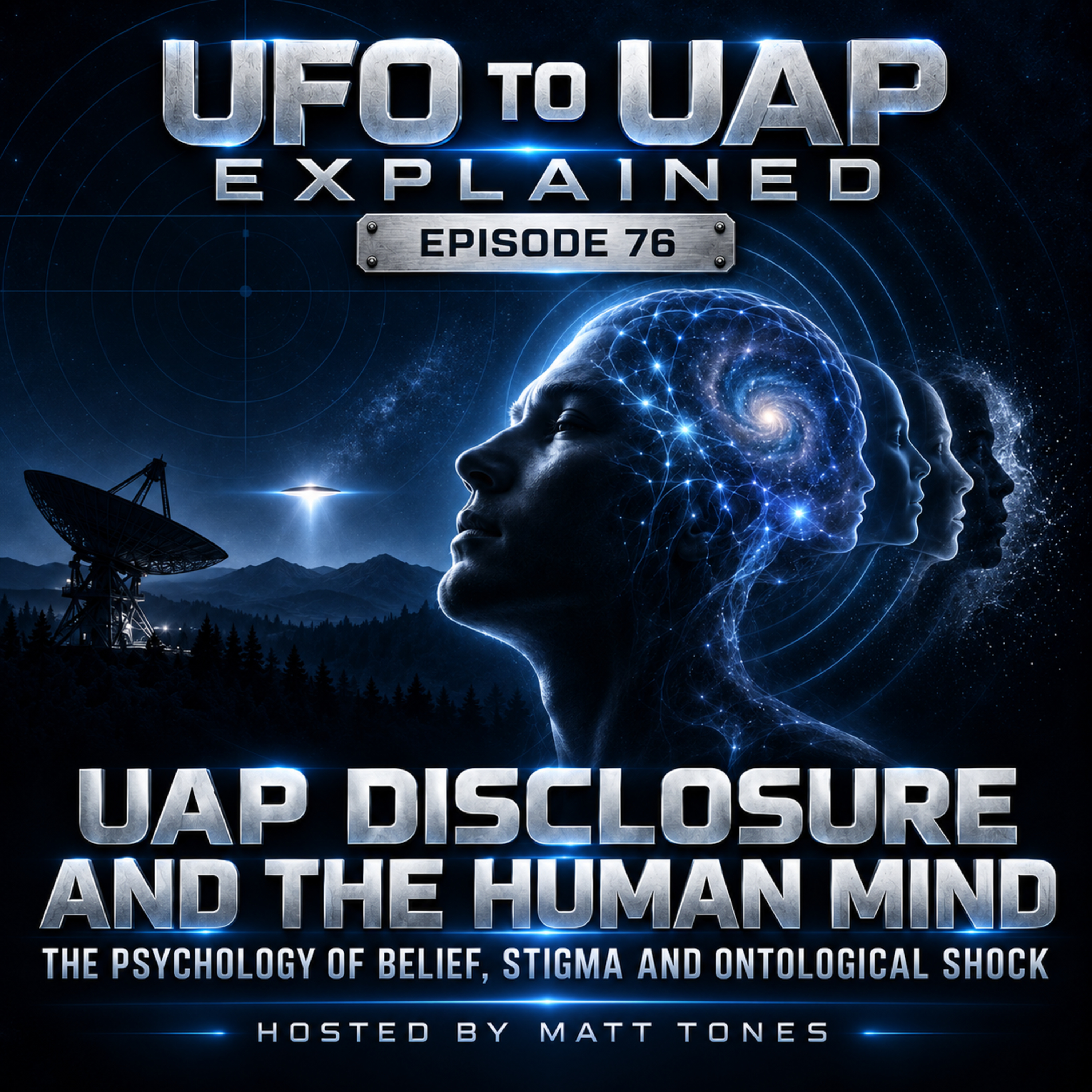
UAP Disclosure and The Human Mind: The Psychology of Belief, Stigma and Ontological Shock
0:00 / 0:00
// Show Notes
UAP disclosure could transform more than our understanding of the skies — it could challenge our understanding of reality itself. In Episode 76 of UFO to UAP Explained, Matt Tones investigates the psychology of UFO belief, UAP stigma and ontological shock: the profound disruption that could occur if credible evidence forced humanity to reconsider what exists, what is possible and whether we are alone. From cognitive dissonance and worldview disruption to religious belief, scepticism and the experiences of UFO witnesses, this episode asks what actually happens to the human mind when the impossible becomes possible.
Could confirmation of non-human intelligence trigger mass panic, or would most people simply adapt? We examine NASA's efforts to reduce stigma around UAP reporting, emerging psychological research into reactions to disclosure, the potential consequences of government secrecy and institutional betrayal, and new calls for psychological preparedness if future UAP revelations become increasingly significant. Crucially, this episode does not assume that UAP represent extraterrestrial or non-human intelligence — it explores what established psychology and emerging research can tell us about how individuals and societies might respond if extraordinary evidence ever arrives.
Keywords:
UAP disclosure, UFO disclosure, ontological shock, psychology of UFO belief, psychological impact of UAP disclosure, UAP psychology, UFO psychology, UAP stigma, UFO stigma, non-human intelligence, NHI disclosure, alien disclosure, extraterrestrial life, cognitive dissonance, government UFO disclosure, UAP witnesses, UAP experiencers, institutional betrayal, NASA UAP, disclosure psychology, UFO to UAP Explained, Matt Tones.
// Episode Transcript
UFO TO UAP EXPLAINED
UAP DISCLOSURE AND THE HUMAN MIND
The Psychology of Belief, Stigma and Ontological Shock
Hosted by Matt Tones
COLD OPEN
What would actually happen if humanity discovered that it was not alone?
Not another blurry video. Not another anonymous source. Not another whistleblower allegation. Not another unexplained object appearing briefly on a military sensor.
Imagine something very different.
Imagine the President of the United States walks to a podium. Or NASA announces an extraordinary scientific discovery. Or several governments release evidence simultaneously.
The message is simple. There is another intelligence. It is real. And somehow, it is here.
What happens next?
For decades, one answer has dominated popular culture. Panic. Markets collapse. Churches empty. People riot. Society fractures. Human civilisation discovers that it is no longer at the centre of reality, and everything falls apart.
But psychology suggests something far more complicated.
Most people might simply go to work the next morning. Some might experience wonder. Some might feel vindicated. Some might become intensely curious. Others might deny the announcement completely. And for a smaller number of people, something much more profound could happen. Their understanding of reality itself could begin to break apart.
Psychologists have a term increasingly appearing in discussions surrounding UAP disclosure. Ontological shock. A confrontation with information so fundamental that it challenges not simply what you believe... but what you believe reality is.
And here is where the UFO question becomes something much larger than UFOs.
Because perhaps the biggest disclosure problem has never been technological. Perhaps it has never even been political. Perhaps the hardest part of disclosure would be us. Our beliefs. Our identities. Our institutions. Our religions. Our trust. And our ability to absorb information that tells us the universe is considerably stranger than we thought.
Today, we're going to investigate what psychology can actually tell us about that possibility. Not speculation disguised as science. Not the assumption that anyone reporting a UFO is psychologically disturbed. And not the assumption that confirmation of non-human intelligence would automatically cause mass panic.
Instead, we're going to examine belief, stigma, uncertainty, cognitive dissonance, institutional trust, experiencers, psychological resilience... and the increasingly serious discussion surrounding what may happen to the human mind if the UAP mystery ever produces an extraordinary answer.
I'm Matt Tones. And this is UFO to UAP Explained.
THE QUESTION HAS CHANGED
For most of modern UFO history, psychology has often been used to explain the witness. Someone reports seeing something extraordinary. The immediate questions become: Were they mistaken? Were they suggestible? Were they hallucinating? Did expectation influence what they perceived? Were they experiencing sleep paralysis? Did memory change after the event?
Those are legitimate scientific questions. Human perception is imperfect. Memory is reconstructive rather than a perfect recording. Expectation can influence interpretation. People can confidently misidentify ordinary objects. And unusual psychological and neurological experiences absolutely can produce perceptions that feel completely real to the person experiencing them.
But something interesting has happened during the modern UAP era. The psychological question is beginning to change.
NASA now openly discusses unidentified anomalous phenomena. The United States Department of Defense maintains an office specifically responsible for investigating them. Military personnel have been encouraged to report unusual observations. Congress has held public hearings. Government reports acknowledge that some cases remain unresolved because available data is insufficient to confidently identify them.
None of this proves extraterrestrial visitation. It does not prove non-human intelligence. It does not prove recovered spacecraft. But it changes the cultural environment in which the subject exists. And once that happens, psychology is no longer relevant only to the person claiming to have seen something. Psychology becomes relevant to everyone processing the possibility.
That is an enormously important distinction.
NASA's 2023 independent UAP study specifically addressed the stigma surrounding reporting. Its panel concluded that negative perceptions associated with UAP reporting were an obstacle to collecting useful data and that NASA's participation could help move the conversation away from sensationalism and toward scientific investigation.
Think about what that means. Stigma isn't simply unpleasant for witnesses. It can interfere with data collection. A pilot sees something unusual. The pilot knows that reporting it might lead colleagues to question their judgement. So the pilot says nothing. The event disappears from the scientific record. And the absence of reports can then reinforce the assumption that serious witnesses rarely encounter unusual phenomena.
That is a feedback loop. Psychology influences reporting. Reporting influences available evidence. Available evidence influences public belief. And public belief influences stigma.
The UFO problem has therefore always contained a psychological component. But that does not mean the phenomenon itself is psychological. Those are two completely different statements.
TODAY'S EPISODE SPONSOR
Today's Episode Sponsor: GrowMyPod.com.
GrowMyPod helps podcasters understand how their show is being discovered, identify gaps in their content strategy, improve episode SEO and build stronger authority around the subjects their audiences are actually searching for. If you're building a podcast and want to understand what to publish next, visit GrowMyPod.com.
Now, back to the episode.
BELIEF IS NOT A DIAGNOSIS
One of the biggest mistakes in conversations about UFOs is collapsing several completely different questions into one. Did someone experience something? What caused that experience? How did they interpret it? And what do they now believe because of it?
Those questions are related. But they are not identical.
A person can accurately describe seeing a light moving across the sky and incorrectly conclude that it was extraterrestrial. Another person can describe exactly the same observation and remain completely uncertain about what it was. Someone else might identify it correctly as a satellite. The observation and the explanation are separate layers.
Psychology becomes particularly important at that second layer. Human beings are meaning-making organisms. We don't like unexplained events. When something important happens, the mind looks for causes. Why did that happen? Who caused it? What does it mean? Does it threaten me? Can I control it?
This is not a UFO-specific behaviour. It is human behaviour.
Research into conspiracy beliefs, for example, has repeatedly examined relationships between uncertainty, perceived control, threat, analytical reasoning and the stories people construct to explain complicated events. A 2023 systematic review examined hundreds of studies in this area and found that conspiracy beliefs have many possible cognitive, motivational, social and cultural contributors.
But critically, relationships between psychological traits and particular beliefs do not mean that every unusual belief represents mental illness. Nor does psychological research allow us to determine whether a specific external event actually happened simply by examining the person who reports it.
That principle matters enormously in the UAP discussion. Because there are two equally problematic extremes.
One says: Anyone reporting something extraordinary must be delusional.
The other says: Anyone sincerely reporting something extraordinary must therefore have encountered something extraordinary.
Neither follows logically. Sincerity does not establish external reality. But unusual testimony does not establish psychopathology either. Serious investigation requires the ability to hold both possibilities open.
LISTENER QUESTION ONE
A listener asks: “If someone genuinely believes they encountered a UFO or even a non-human intelligence, does psychology consider that person mentally ill?”
No. Not simply because of the belief or report itself. Clinical assessment is considerably more complicated than identifying one unusual claim. Mental health professionals examine patterns of thought, functioning, distress, behaviour, context, medical factors and many other variables.
And there is another principle that matters here. A clinician can acknowledge that someone's distress is real without claiming certainty about what caused the experience.
If someone says: “I saw something that terrified me.” A psychologically responsible response is not necessarily: “Yes, you definitely encountered aliens.” But neither is it automatically: “No, you imagined everything.”
It can be: “Something happened that affected you deeply. Let's understand what you experienced and how it is affecting you.”
That distinction may become extremely important if UAP encounters continue entering mainstream scientific and governmental discussion.
THE STIGMA PROBLEM
Stigma has followed the UFO subject for decades. The flying saucer witness became a cultural stereotype. The person in the tinfoil hat. The unreliable observer. The conspiracy theorist. The person who sees aliens everywhere. Humour became part of the social regulation of the subject. And humour can be powerful. If reporting something threatens social status, employment or professional credibility, people learn very quickly what they are allowed to discuss.
NASA's UAP study heard first-hand accounts concerning reporting stigma and concluded that it likely contributes to lost data. The Defense Department has similarly discussed efforts to reduce reporting stigma among pilots.
That doesn't mean every unreported observation would be extraordinary. In fact, increasing reporting should produce more ordinary explanations as well. More balloons. More aircraft. More satellites. More drones. More astronomical objects. More sensor artefacts. That's exactly what better reporting should accomplish.
Good science does not reduce stigma so that witnesses can prove aliens exist. It reduces stigma so that observations enter the dataset. Then investigation begins. This difference is fundamental.
But there is another consequence of stigma. It affects the person reporting the experience.
Imagine witnessing something you cannot explain. Something close. Something apparently structured. Something that behaves in a way you cannot reconcile with your understanding of aircraft. Perhaps another person sees it too. You begin questioning yourself. You tell your partner. They laugh. You tell a colleague. They stop laughing and warn you not to mention it at work. You search online. Now you're confronted with everything simultaneously. Scientific investigations. Government documents. Alien abduction stories. Hoaxes. Conspiracy theories. Spiritual interpretations. Secret space programmes. Interdimensional beings. Military aircraft. Drones. Sleep paralysis. Prophecy.
You entered the subject because of one unexplained experience. Within hours, you're navigating an entire alternative universe of competing explanations.
Psychologically, that is an extraordinary environment. And this leads us to the central concept of today's episode.
WHAT IS ONTOLOGICAL SHOCK?
Ontology is a branch of philosophy concerned with being and existence. What exists? What is reality made of? What kind of world are we living in?
In current UAP discussions, ontological shock describes the disorientation that can occur when something challenges a person's basic understanding of reality. The term has increasingly moved into psychological discussions surrounding UAP.
In August 2026, the Psychological Alliance for Transparency and Humanity, or PATH, described ontological shock as something beyond ordinary surprise: a challenge to assumptions about what exists, what is possible and what reality fundamentally is.
Importantly, ontological shock is not currently a psychiatric diagnosis. You will not find “UAP ontological shock disorder” in a diagnostic manual. It is better understood as a descriptive concept. And psychology already studies many related processes. Worldview disruption. Meaning-making. Cognitive dissonance. Identity threat. Existential anxiety. Belief revision. Traumatic stress. Uncertainty. All of these can become relevant when information conflicts with deeply held assumptions.
Psychologists Travis Proulx and Steven Heine have described how violations of expected meaning can create psychological arousal and motivate people either to assimilate anomalies into existing frameworks or alter those frameworks to accommodate new information.
In simple terms: The brain likes a world that makes sense. When something doesn't fit, we try to make it fit. And that is where UAP disclosure becomes psychologically fascinating. Because the phrase “disclosure” can describe very different scenarios.
DISCLOSURE IS NOT ONE EVENT
Suppose tomorrow the Pentagon releases another hundred UAP videos. Most are ambiguous. Several remain unexplained. That is one kind of disclosure. Psychological impact? Probably limited.
Now imagine the government announces that some objects demonstrate technology it cannot attribute to any known nation. That is much more significant. But it still doesn't establish aliens.
Now imagine multiple scientific institutions announce that an engineered object of unquestionably non-human origin has been recovered. Psychologically, that is another category entirely.
And now take the most extreme scenario. An intelligence exists. It has been interacting with Earth. Governments have known. Physical materials exist. Communication has occurred. And evidence is released that independent scientists can verify. At that point, the event is not merely about UFOs. It becomes a civilisation-level update to humanity's model of reality.
A 2026 Disclosure Foundation research report examined precisely this spectrum of potential psychological responses. The Foundation is a UAP transparency advocacy organisation, not a government health authority, which is important context. But its report brought together clinical and academic contributors and drew from existing research in psychology, public health and crisis communication.
Its central conclusion was not that humanity would collapse. Quite the opposite. The report argued that responses would probably vary widely, that most people would likely adapt without lasting psychological impairment and that vulnerability would likely be concentrated among smaller groups. It suggested that one of the more realistic concerns would be temporary pressure on mental-health services rather than universal mass panic.
That conclusion deserves attention. Because the idea that disclosure would automatically produce mass hysteria is one of the oldest assumptions surrounding the UFO subject.
WOULD PEOPLE ACTUALLY PANIC?
Whenever people discuss alien disclosure and public panic, one historical event appears almost automatically. October 30th, 1938. Orson Welles broadcasts The War of the Worlds.
The story has been repeated countless times. Americans hear fictional radio reports of Martians invading New Jersey. Listeners believe the broadcasts. Nationwide panic erupts. People flee into the streets. Society nearly loses control. And governments supposedly learn a lesson: Humanity cannot handle alien contact.
There is only one problem. The famous story appears to have been considerably exaggerated. Some listeners absolutely were frightened. Police and media organisations received calls. Some people misunderstood the broadcast. But later historical research concluded that the popular image of nationwide hysteria was amplified by contemporary newspaper coverage. Even the scale of the audience itself was smaller than mythology later suggested.
This matters because “the public would panic” is often treated as an established psychological fact. It isn't.
Humans regularly absorb extraordinary information. Wars begin. Governments fall. Pandemics spread. Terrorist attacks happen. Natural disasters destroy communities. Scientific discoveries change our understanding of nature. People experience fear, confusion and grief. But they also adapt. Human beings are extraordinarily psychologically flexible.
The more realistic question isn't: Would humanity panic? It is: Who would struggle, why would they struggle, and what conditions would make adaptation easier or harder?
LISTENER QUESTION TWO
Another listener asks: “Would religious people be the group most affected by confirmation of non-human intelligence?”
Not necessarily. This assumption is surprisingly common. The logic usually goes like this. Religion teaches that humans occupy a special place in creation. Aliens would challenge human uniqueness. Therefore religion would collapse.
But religious traditions have spent centuries adapting to changes in cosmology. Earth stopped being understood as the physical centre of the universe. The universe became vastly older than traditional chronologies suggested. Evolution transformed biological understanding. Different traditions responded differently. Some resisted. Some reinterpreted doctrine. Some incorporated the new knowledge remarkably easily. And the same could occur with non-human intelligence.
For some religious people, extraterrestrial life might create theological difficulty. For others, it could simply enlarge creation.
The same principle applies to atheists. Imagine someone whose worldview includes absolute certainty that consciousness is produced only by human and animal brains on Earth and that technologically advanced non-human intelligence is effectively impossible. If incontrovertible evidence suddenly appeared, that worldview would also require revision.
Ontological shock is not reserved for believers. It can affect anyone whose identity depends heavily on certainty. The religious believer. The committed materialist. The lifelong sceptic. The lifelong UFO advocate. Everyone carries a model of reality. And everyone has something to update when reality refuses to obey it.
WHAT COGNITIVE DISSONANCE MIGHT LOOK LIKE
Imagine you've spent thirty years publicly arguing that UFOs are nonsense. Your professional identity is attached to that position. You've written books about it. You've mocked witnesses. You've appeared on television saying there is nothing there.
Then authoritative evidence emerges proving that at least one extraordinary interpretation was correct. You now face a conflict. The evidence says one thing. Your identity says another. That's cognitive dissonance.
People often imagine that overwhelming evidence automatically changes minds. It doesn't always. Sometimes overwhelming evidence makes people defend existing beliefs more strongly because the belief is connected to identity.
Now reverse the scenario. Imagine you've spent thirty years believing that UFOs are extraterrestrial spacecraft. You believe governments possess alien bodies. You believe secret treaties exist. You believe particular whistleblowers. Disclosure finally occurs. But the evidence reveals something radically different. Perhaps there is a genuine phenomenon, but many of the stories you believed are false. Or perhaps an unexplained intelligence exists but has nothing to do with extraterrestrial visitors.
Your worldview faces exactly the same problem.
Disclosure could destabilise sceptics. But it could also destabilise believers. Because confirmation of something extraordinary would not automatically confirm every story built around the mystery. That could become one of the most difficult psychological dynamics of disclosure. Evidence might resolve one uncertainty while creating a hundred others.
THE EXPERIENCER PROBLEM
There is another group that deserves particular attention. People who already believe they have had direct anomalous experiences. UAP sightings. Close encounters. Missing-time experiences. Perceived communication. So-called contact experiences. Reports sometimes interpreted as abduction.
This area demands extraordinary care.
The existence of testimony does not establish that the experiencer's interpretation is objectively correct. There are known phenomena capable of producing extraordinary subjective experiences. Sleep paralysis. Hypnagogic and hypnopompic hallucinations. Neurological conditions. Memory distortion. Trauma. Suggestion. Dream states. Substance effects. Psychiatric conditions. Misidentification. These must remain part of any responsible discussion.
But here's the important point. Whatever the ultimate cause, people can experience these events as profoundly real. The distress can be real. Relationship breakdown can be real. Fear can be real. Isolation can be real. Changes in identity can be real. And stigma can make all of those things harder to process.
A 2026 symposium organised by the John Mack Institute included discussion of mental health, meaning-making and support for people reporting anomalous experiences. Preliminary work presented there on alleged alien-abduction experiences found that the existing scientific literature is highly heterogeneous and generally low quality, with no single explanatory framework sufficiently accounting for the entire body of reports.
That is exactly where scientific humility should operate. Not knowing is not permission to believe anything. But not knowing is also not permission to ridicule everyone.
THE CLINICAL CHALLENGE
Imagine being a psychologist. A patient enters your office and says: “I know this sounds insane, but something happened to me.”
What should the clinician do?
One approach is immediate confirmation. “Yes. Aliens visited you.” That would be irresponsible without evidence. Another approach is immediate dismissal. “You imagined it.” That can also be harmful.
There is a third path. Treat the person seriously. Assess psychological and medical possibilities. Explore the experience. Evaluate distress and functioning. Remain neutral regarding claims that cannot be established. Help the person integrate what happened without imposing an explanation.
This is increasingly becoming part of the emerging conversation surrounding anomalous experiences. PATH, formed as a professional network concerned with psychological preparedness around UAP disclosure, has specifically begun developing guidance around psychological first aid and trauma-informed responses.
Again, that should not be interpreted as proof that NHI exists. Its significance is different. Mental-health professionals are beginning to ask whether the profession has adequate frameworks for people distressed by anomalous experiences or potentially paradigm-changing information. That is itself culturally significant.
INSTITUTIONAL BETRAYAL
Now we arrive at what may be the most explosive psychological component of genuine disclosure. Not aliens. Government secrecy.
Imagine for a moment that extraordinary evidence is eventually confirmed. And then imagine that documents prove governments had possessed compelling evidence for decades. The first public question would probably be: What is it? The second might become: Who knew? And the third: Why didn't they tell us?
This moves the psychology from ontological shock into institutional trust.
Psychology has a concept called institutional betrayal. It describes harms that can occur when institutions people depend on fail to protect them, conceal important information, deny experiences or violate expectations of trust. Research has associated institutional betrayal with reduced trust and psychological distress in several contexts.
Now apply that cautiously to a hypothetical UAP disclosure. Suppose a government said: “Non-human intelligence is real, and elements within the state have known since 1947.”
The psychological event would contain two revelations. The first: We are not alone. The second: The institutions entrusted with informing democratic society concealed one of the most significant discoveries in human history.
For some people, the second revelation might be more destabilising than the first. Because an alien civilisation doesn't manage your taxes. It doesn't regulate your healthcare. It doesn't command your military. It doesn't run intelligence services in your name. Your government does.
The 2026 Disclosure Foundation report raises institutional betrayal as a potential factor in how people could respond to disclosure, arguing that trust and communication might become as psychologically important as the underlying revelation itself.
That is a powerful idea. The psychological danger may not simply be what authorities reveal. It may be what the revelation implies about everything authorities previously denied.
LISTENER QUESTION THREE
A listener asks: “Could governments legitimately hide the truth about UFOs because they believe people would panic?”
Psychology does not give governments a blank cheque for secrecy. There is no established scientific finding showing that humanity would collapse if extraterrestrial or non-human intelligence were confirmed. In fact, available research suggests responses would probably be diverse. Many people would adapt. Some would experience excitement or curiosity. Some would experience anxiety. Some would deny the information. Some might experience severe distress.
But using hypothetical mass panic as a permanent justification for withholding information would require evidence. And secrecy itself has consequences. Rumour expands in information vacuums. Distrust grows. Conspiracy theories flourish. Contradictory explanations multiply. If authorities eventually reverse decades of denial, earlier secrecy can become part of the psychological crisis.
So the communication problem becomes extraordinarily difficult. Too little information creates speculation. Too much unstructured information creates confusion. Contradictory messaging destroys credibility. And certainty unsupported by evidence creates future distrust.
The most psychologically responsible communication might therefore be the least dramatic: Here's what we know. Here's the evidence. Here's what we don't know. Here's what we're investigating. And here is what we absolutely cannot yet conclude. That happens to be good scientific communication too.
WHY UNCERTAINTY MAY BE HARDER THAN DISCLOSURE
There is another possibility that gets less attention. Maybe the psychologically difficult period isn't after disclosure. Maybe we're already inside it.
Think about the modern information environment. Government videos are authentic, but interpretation is disputed. Military witnesses describe extraordinary events, but publicly available sensor evidence is incomplete. Whistleblowers make allegations that remain partly or wholly unverified. Officials acknowledge unresolved cases without identifying their origin. Some former intelligence figures make extraordinary claims. Other officials reject them. Documents are classified. Others are released. Images circulate without provenance. AI-generated material makes visual evidence increasingly difficult to trust. Everyone is watching the same mystery through different information ecosystems.
That environment can create chronic uncertainty. And psychologically, chronic uncertainty can be more exhausting than a difficult answer. Humans often tolerate bad news better once they understand what they are dealing with. Uncertainty keeps the threat system active.
Maybe something is happening. Maybe nothing extraordinary is happening. Maybe governments know. Maybe they don't. Maybe whistleblowers are revealing history's greatest secret. Maybe they're sincerely mistaken. Maybe the phenomenon is technological. Maybe psychological. Maybe atmospheric. Maybe extraterrestrial. Maybe several categories are being confused together. There is no stable resolution.
For people deeply immersed in the subject, this can become psychologically consuming. Every new statement becomes evidence. Every delay becomes evidence. Every denial becomes evidence. Every unexplained video becomes evidence. Eventually the UFO question can stop being something a person investigates... and become the framework through which they interpret everything.
That is where critical thinking becomes essential.
BELIEF, SCEPTICISM AND IDENTITY
There is a simple principle worth remembering. A belief should be allowed to change. “I don't know” is psychologically uncomfortable. But epistemically, it is incredibly powerful.
You can believe that some UAP cases deserve serious investigation without believing they are extraterrestrial. You can believe witnesses deserve respect without believing every interpretation. You can believe governments conceal information without concluding that every conspiracy theory is correct. You can believe non-human intelligence is possible without claiming it has visited Earth. And you can remain sceptical without treating witnesses as idiots.
That middle ground is difficult because certainty feels better. The believer knows. The debunker knows. The conspiracy theorist knows. The official spokesperson knows. Everyone knows. Until the evidence changes.
Perhaps the healthiest psychological position toward UAP is neither belief nor disbelief. It is calibrated uncertainty. A willingness to say: “This is what the evidence currently supports.” “This is what it might mean.” “And this is where I stop.”
WHAT WOULD HAPPEN THE DAY AFTER?
Let's return to our opening scenario. Tomorrow morning, authoritative institutions announce independently verified evidence of non-human intelligence. What happens?
Probably many things at once. Some people cry. Some people pray. Some celebrate. Some become frightened. Some call family members. Some immediately question whether the announcement is fake. Social media explodes. Financial markets react. Religious leaders release statements. Scientists demand access to evidence. Governments hold emergency meetings. Conspiracy communities split into competing interpretations. People who reported experiences for decades say: “I told you.” Others ask whether their own unexplained memories now mean something different.
And millions of people probably make coffee. Drive to work. Take children to school. Open their laptops. Because rent is still due.
This is something grand theories about disclosure often miss. Human life has extraordinary momentum. Even civilisation-changing information has to compete with breakfast. That does not diminish the significance of the revelation. It demonstrates human adaptability.
LISTENER QUESTION FOUR
Our final listener question is: “How should someone psychologically prepare for the possibility that UAP disclosure really does happen?”
The answer is not to choose an explanation now. You do not need to decide that aliens are here in order to prepare yourself for extraordinary evidence.
Psychological preparation may actually mean becoming more comfortable with uncertainty. Ask yourself which beliefs you treat as untouchable. Could you change your mind? Could you discover that something you dismissed was real? Could you discover that something you believed passionately was wrong? Could you tolerate an answer that created more questions than it solved? Could you separate evidence from identity?
Could you say: “I believed this yesterday because it was the best explanation available. Today I have better information. So I've changed my mind.”
That isn't weakness. That is intellectual resilience. And perhaps ontological resilience works the same way. The strongest worldview may not be one that can never be challenged. It may be one capable of expanding.
PSYCHOLOGICAL PREPAREDNESS IN 2026
This discussion is no longer completely theoretical.
On June 19th, 2026, the Disclosure Foundation published The Psychological Impact of UAP/NHI Disclosure, examining potential public responses and psychological preparedness. On July 30th, it followed with a policy proposal advocating a national preparedness framework addressing the potential human consequences of disclosure. Then, during August 2026, PATH published material specifically discussing the psychology of disclosure, ontological shock and psychological first aid.
These initiatives are not evidence that disclosure of NHI is imminent. They are not evidence that governments possess alien spacecraft. They are not evidence that extraterrestrial beings are visiting Earth. And organisations advocating preparation should not be confused with neutral confirmation that the event being prepared for will occur.
But they demonstrate something important. The UAP discussion is expanding. The question is no longer only: What are these objects? It is also becoming: What happens to people if the answer is extraordinary?
That's a legitimate question. Even if the extraordinary answer never arrives. Because the way societies process uncertainty, stigma and worldview-threatening information matters far beyond UFOs.
ONTOLOGICAL SHOCK MAY NOT BE A COLLAPSE
There is one final misunderstanding worth correcting. A shock to your worldview does not necessarily destroy it. Sometimes it enlarges it.
Human beings have repeatedly discovered that reality is bigger than expected. Earth was not the centre of the cosmos. The stars were not lights attached to a nearby celestial sphere. Our galaxy was not the entire universe. There are hundreds of billions of galaxies. Matter is built from structures invisible to ordinary human perception. Space and time are intertwined. Gravity bends light. The universe has a history measured in billions of years. Life evolves. Continents move. Black holes exist. Planets orbit other stars.
Each discovery changed humanity's picture of reality. And yet people adapted.
If non-human intelligence were someday established, it would be another expansion. Perhaps the largest one yet. But expansion is not annihilation. You would still love the same people. Music would still matter. Art would still matter. Children would still laugh. Grief would still hurt. Friendship would still matter. Human civilisation would not become meaningless simply because humanity discovered another intelligence.
If anything, the discovery might force us to confront an uncomfortable question. Not whether we are important to the universe. But whether we require the universe to declare us unique before we can consider ourselves important.
CONCLUSION
For seventy years, the UFO debate has often divided people into two psychological caricatures. The believer. And the sceptic. One supposedly believes anything. The other supposedly believes nothing. Reality is far more complicated.
Witnesses can be sincere and mistaken. Sceptics can be rational and wrong. Governments can investigate unexplained phenomena without possessing alien spacecraft. Unexplained does not mean extraterrestrial. And psychological explanations for some experiences do not establish psychological explanations for every case.
That uncertainty is uncomfortable. But it is also where serious investigation begins.
If UAP disclosure eventually produces an ordinary answer, psychology will remain part of understanding why the mystery became so culturally powerful. If it produces several different answers, psychology will help us understand how people reconcile conflicting information. And if, one day, credible and independently verifiable evidence establishes the existence of another intelligence... psychology may suddenly become one of the most important disciplines in the world.
Because after the physicists determine what it is... after the engineers determine how it works... after governments determine what it means for national security... human beings will still have to answer another question.
What does this mean for us? For our identity. For our history. For our religions. For our institutions. For our understanding of consciousness. For our place in the universe. And perhaps the deepest question of all: What happens when something we once considered impossible becomes part of ordinary reality?
Maybe humanity would panic. Maybe some people would. Maybe others would experience the greatest sense of wonder of their lives. But perhaps the real lesson from psychology is simpler. Human beings are remarkably good at rebuilding their understanding of reality. We've done it before. We may have to do it again.
And if that moment ever comes... the greatest challenge of disclosure may not be discovering what is out there. It may be discovering whether we are prepared to change what we believe is possible.
I'm Matt Tones. This has been UFO to UAP Explained.
If this episode made you reconsider the human side of disclosure, follow the show and share it with someone who approaches this subject differently from you. Because whether you're a believer, a sceptic, or somewhere between the two... the most important skill in investigating the unknown may be the willingness to change your mind when the evidence changes.
Until next time... keep questioning. Keep investigating. And never confuse the unexplained with the impossible.
SOURCES CONSULTED
- NASA, Unidentified Anomalous Phenomena Independent Study Team Report, September 2023. NASA concluded that stigma surrounding UAP reporting interferes with data collection and emphasised scientific, transparent investigation.
- U.S. Department of Defense, DOD Examining Unidentified Anomalous Phenomena, November 2024. Includes discussion of efforts to reduce UAP reporting stigma among pilots and improve reporting.
- Disclosure Foundation, The Psychological Impact of UAP/NHI Disclosure: A Framework for Understanding Public Response and Preparedness, June 19, 2026.
- Disclosure Foundation, A National Preparedness Framework for the Human Consequences of Disclosure, July 30, 2026.
- Psychological Alliance for Transparency and Humanity — PATH, Ontological Shock: What Psychology Can Tell Us, August 16, 2026, and its psychological-preparedness resources.
- Tim Lomas, Unidentified Anomalous Phenomena Disclosure as Ontological Shock? Exploring Diversity Among Social Media Responses to a Congressional UAP Hearing, Journal of Humanistic Psychology.
- Irena Pilch, Agnieszka Turska-Kawa and colleagues, Contemporary Trends in Psychological Research on Conspiracy Beliefs: A Systematic Review, Frontiers in Psychology, 2023.
- Travis Proulx and Steven J. Heine, The Frog in Kierkegaard's Beer: Finding Meaning in the Threat-Compensation Literature, Social and Personality Psychology Compass, 2010.
- John Mack Institute, Breaking the Taboo: Reviving Academic UAP, Abduction, and Experiencer Research, July 2026 symposium programme and research presentations.
- Smithsonian Magazine and PBS American Experience, historical analysis of the 1938 War of the Worlds broadcast and the later exaggeration of the mass-panic narrative.