Loading episode...
EP.36
May 14, 202600:19:38Season 1
The Private Sector Vault: Are Aerospace Giants Hiding UFO Tech?
0:00 / 0:00
// Show Notes
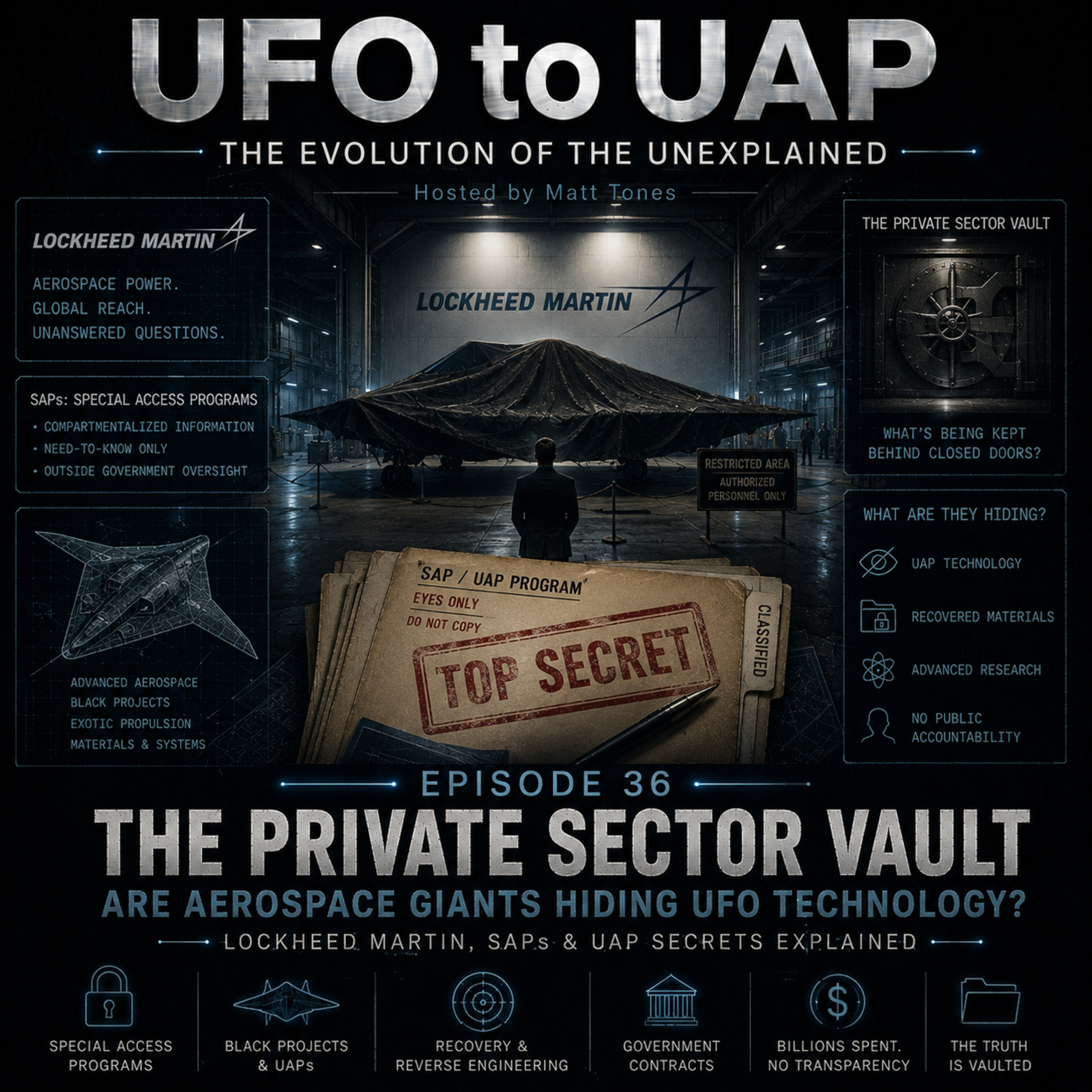
Could the deepest UFO and UAP secrets be hidden not inside the Pentagon, but within private aerospace companies protected by classified contracts and special access programs?
In this episode of UFO to UAP Explained, host Matt Tones investigates claims that crash-retrieval materials, reverse-engineering efforts and advanced aerospace technology may have been transferred to private contractors. The episode explores how government secrecy became fragmented after the Cold War, with companies such as Lockheed Martin, Northrop Grumman, Boeing and General Dynamics playing major roles in classified defence development.
The investigation examines special access programs, David Grusch’s whistleblower allegations, the disputed Wilson memo and the limits of Freedom of Information laws when records sit inside corporate systems. It also explores Lockheed Martin’s Skunk Works, the history of secret aircraft, the difficulty of reverse-engineering unknown technology and the eminent-domain language proposed in the UAP Disclosure Act.
Are aerospace giants hiding recovered UFO technology, or has real classified aviation history fuelled a powerful modern myth? The episode separates documented secrecy structures from unverified claims while asking who controls advanced technology—and whether congressional oversight can reach the private-sector vault.
Keywords:
private aerospace UFO technology, aerospace contractors UAP, Lockheed Martin UFO claims, Skunk Works UFO technology, David Grusch allegations, Wilson memo, special access programs, crash retrieval programs, reverse engineering UFOs, UAP Disclosure Act, eminent domain UAP, private contractor secrecy, Pentagon UFO investigation, congressional UAP oversight, classified aerospace programs, military-industrial complex, recovered alien technology, government UFO secrecy, UAP disclosure, unidentified anomalous phenomena, UFO podcast.