Loading episode...
EP.35
May 8, 202600:26:21Season 1
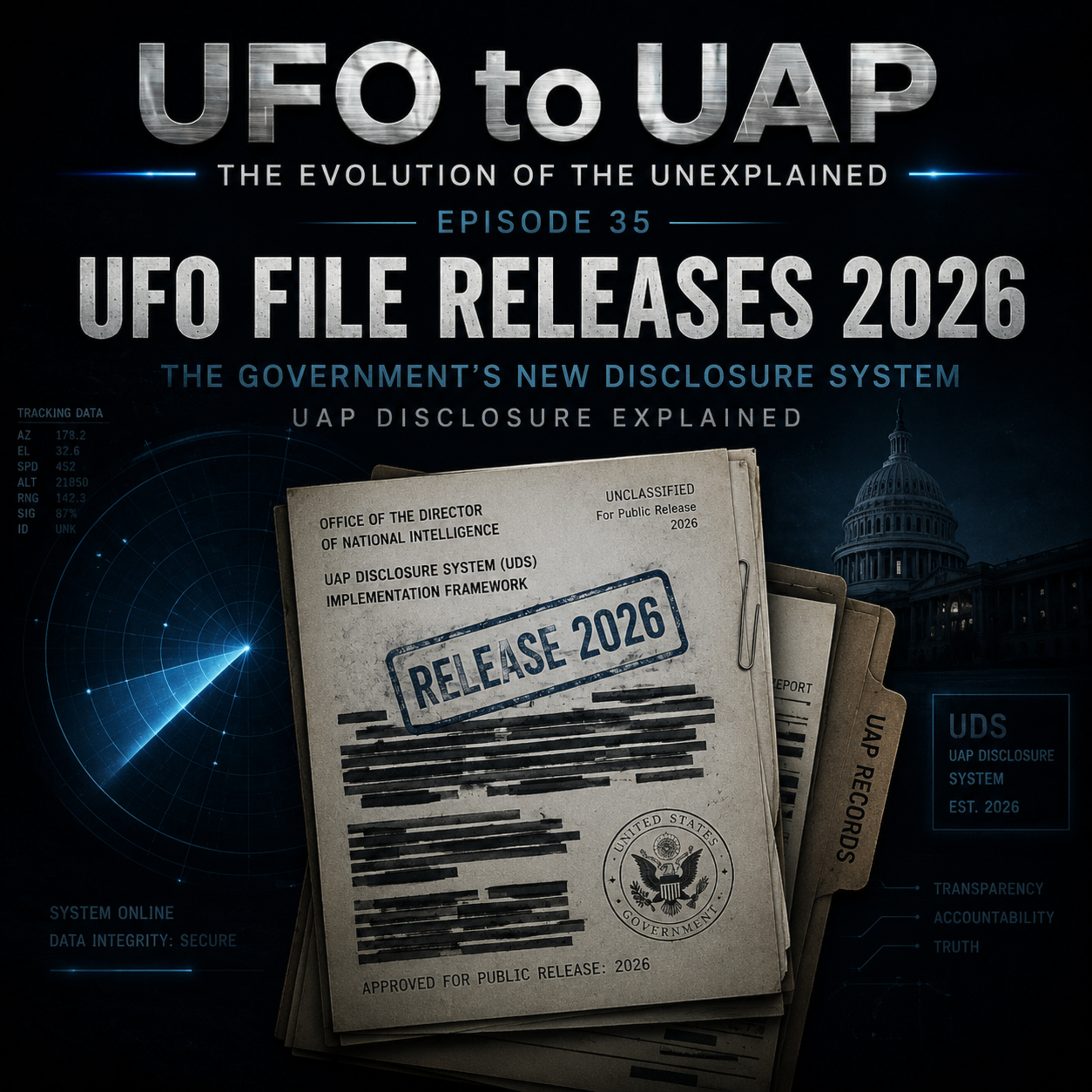
The 2026 UFO Rollout: Inside the Government’s Declassified Portal
0:00 / 0:00
// Show Notes
What does the reported 2026 government UFO disclosure portal actually reveal—and is it genuine transparency, controlled disclosure or a carefully managed information strategy?
In this episode of UFO to UAP Explained, host Matt Tones investigates the May 2026 UFO rollout and the architecture behind a government-branded archive of declassified documents, images, videos and incident reports. Rather than focusing only on whether one file proves extraterrestrial visitation, the episode asks why officials are building a permanent system for releasing and framing UAP information.
Explore the portal’s interactive design, references to hidden assets and future releases, the “17 pages” theory, government messaging and the role of online investigators analysing metadata, source code and archive structures. The episode also examines how military videos, congressional hearings, whistleblower testimony, AARO investigations and the shift from UFO to UAP have gradually normalised the subject.
Could the rollout be public acclimatisation, institutional trust-building, strategic ambiguity or a mask for classified aerospace technology? No released file provides conclusive proof of non-human intelligence, but the organised infrastructure may signal a major change in how governments manage UFO information, public attention and national-security narratives.
Keywords:
2026 UFO disclosure, government UFO portal, declassified UFO archive, UAP disclosure, controlled disclosure, UFO acclimatisation, government transparency, hidden UFO files, 17 pages UFO portal, AARO, congressional UAP hearings, military UFO videos, UAP whistleblowers, UFO information control, classified aerospace technology, strategic ambiguity, non-human intelligence, unidentified anomalous phenomena, Pentagon UFO investigation, UFO to UAP Explained.