Loading episode...
EP.8
Apr 5, 202600:14:07Season 1
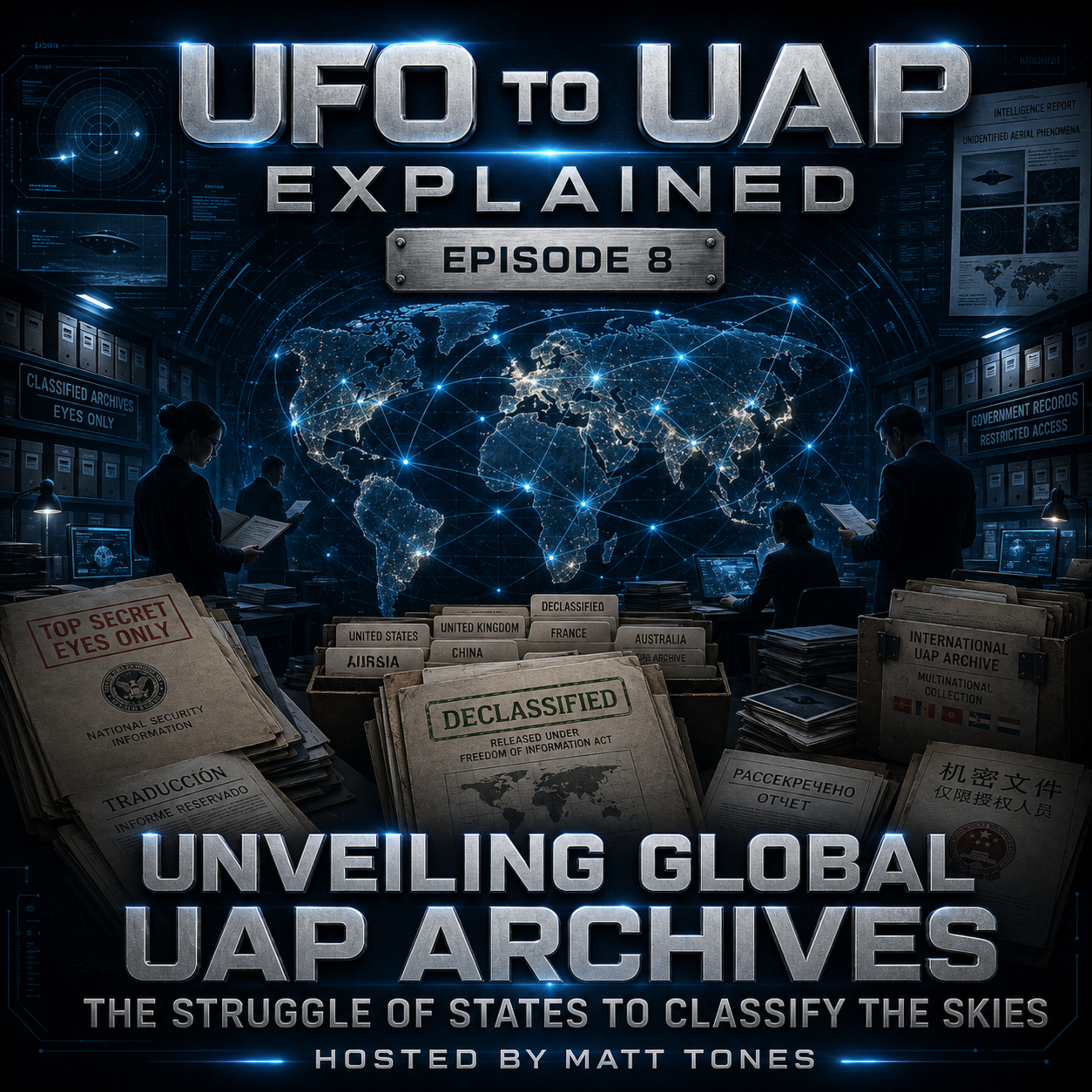
Unveiling Global UAP Archives: The Struggle of States to Classify the Skies
0:00 / 0:00
// Show Notes
What do global government UFO archives reveal when files from the United States, United Kingdom, France, Australia, New Zealand and Brazil are compared side by side?
In this episode of UFO to UAP Explained, host Matt Tones investigates the hidden pattern inside official UAP file releases. The episode explains why large document releases usually reflect Freedom of Information laws, audits, declassification cycles and archive policy—not sudden waves of UFO activity.
The investigation identifies two major periods of institutional attention: the early Cold War, when radar and air-defence networks expanded, and the late 1970s to 1980s, when mature surveillance systems, civil aviation and geopolitical tension produced more documented encounters. It also reveals where significant cases cluster: military airspace, radar zones, airports, weapons ranges, nuclear-risk sites and coastal defence corridors.
Explore the difference between operational peaks involving military witnesses, radar returns and fighter scrambles, and social reporting peaks amplified by media, culture and misidentification. From CIA and FBI records to the UK Ministry of Defence, France’s GEIPAN, Australia’s RAAF files, New Zealand’s defence archive and Brazil’s 1986 Official UFO Night, discover why the archives may reveal less about when UFOs arrive—and more about when governments lose confidence in their ability to classify the sky.
Keywords:
global UAP archives, government UFO files, declassified UFO documents, international UAP investigations, CIA UFO files, FBI UFO records, UK Ministry of Defence UFO files, GEIPAN France, RAAF UFO archive, New Zealand UFO files, Brazil Official UFO Night, Cold War UFO reports, military radar UAP evidence, air-defence UFO encounters, UFO reporting waves, Freedom of Information UFO files, government UAP transparency, unidentified anomalous phenomena, UFO to UAP Explained.