Loading episode...
EP.79
Sep 13, 202600:28:45Season 1
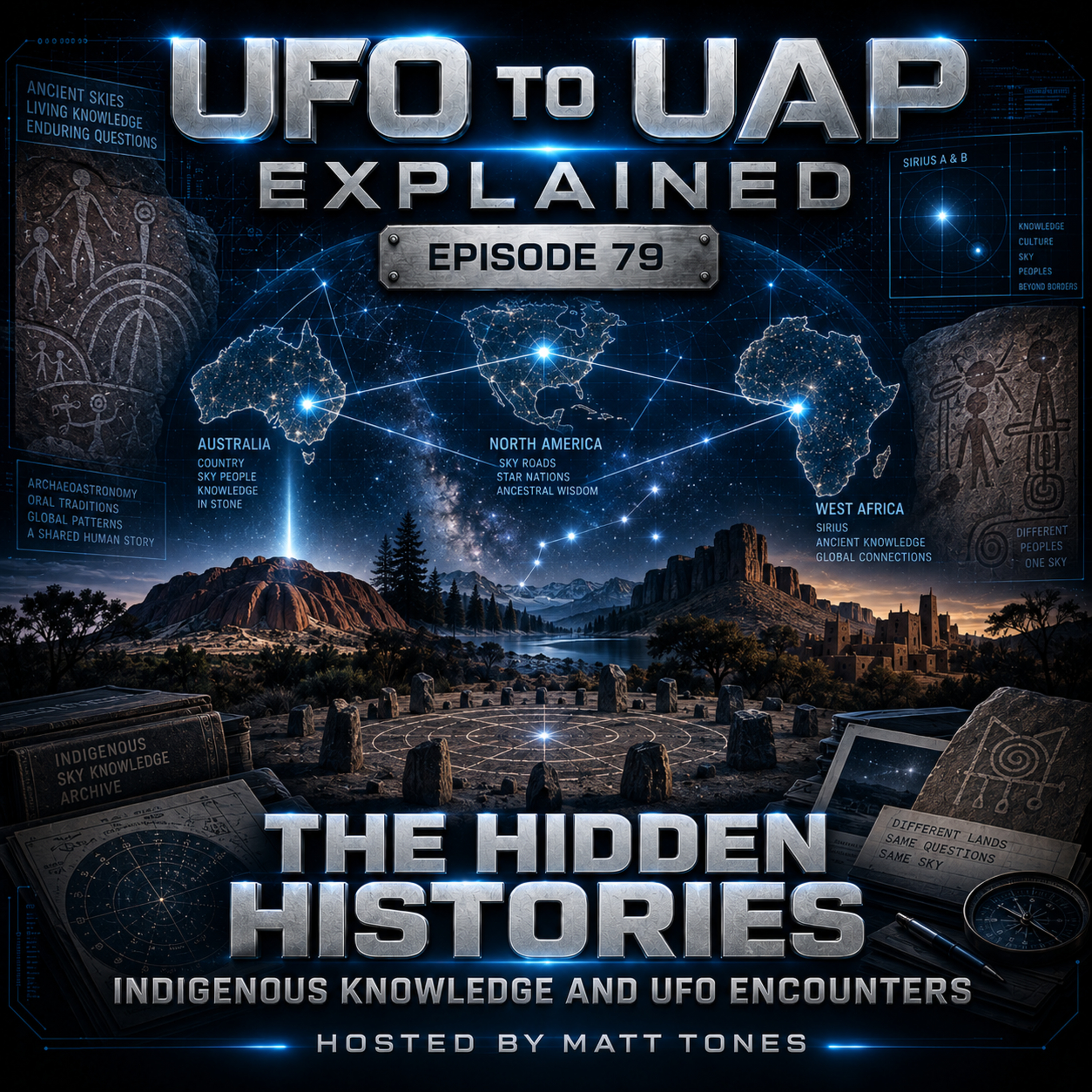
The Hidden Histories: Indigenous Knowledge and UFO Encounters
0:00 / 0:00
// Show Notes
Long before UFOs, UAP or modern astronomy, cultures around the world were already looking to the sky for knowledge, origins and meaning. In Episode 79 of UFO to UAP Explained, Matt Tones investigates The Hidden Histories: Indigenous Knowledge and UFO Encounters — from Aboriginal Australian sky knowledge, Baiame and the Wandjina, to Wurdi Youang’s possible solar alignments, Lakota traditions of star beings and Fallen Star, and the controversial Dogon claims surrounding Sirius B. Rather than forcing ancient traditions into a modern extraterrestrial framework, this episode asks what these cultures actually said, what the evidence supports, and where later UFO interpretations may have rewritten the story.
Could stories of beings descending from the sky preserve memories of genuine anomalous encounters — or are we seeing spirituality, astronomy, oral history and modern expectations collide? We examine Indigenous astronomical knowledge, sacred geography, songlines, “Star People” traditions, the Dogon Sirius controversy, colonial distortion of oral knowledge, and whether traditional observation can contribute meaningfully to modern UAP research. The conclusion is more complex than “ancient aliens”: Indigenous knowledge does not need extraterrestrials to be extraordinary.
Keywords:
Indigenous UFO encounters, Indigenous sky knowledge, Aboriginal astronomy, Aboriginal UFO stories, Baiame, Wandjina, Wurdi Youang, Aboriginal star maps, Indigenous astronomy, Native American Star People, Lakota Star People, Fallen Star, Tapun Sa Win, Dogon Sirius mystery, Dogon Sirius B, ancient astronauts, ancient alien theory, sky beings, celestial knowledge, Indigenous oral traditions, UFO history, UAP history, extraterrestrial contact, UFO to UAP Explained, Matt Tones
// Episode Transcript
UFO TO UAP EXPLAINED
EPISODE 79
THE HIDDEN HISTORIES
Indigenous Knowledge and UFO Encounters
Hosted by Matt Tones
Cold Open
Imagine standing somewhere in Australia thousands of years before electric light.
No cities. No aircraft. No satellites crossing the night.
Above you, the Milky Way stretches from one horizon to the other.
The sky is not background. It is a map. A calendar. A memory. A place inhabited by ancestors.
And somewhere within the stories carried from generation to generation is the account of a powerful being associated with the sky. A being who comes down. Walks upon the land. Creates. Teaches. Establishes law. And eventually returns above.
Now cross an ocean. Among the Lakota of North America, another story survives. A mysterious man appears. He tells the people that he comes from the stars. A woman travels with him to his home in the heavens. Their child will eventually return to the people below. And he will bring knowledge.
Now travel again. To Mali. To the Dogon. Here we encounter one of the most extraordinary claims ever attached to an Indigenous culture. That people without modern telescopes somehow possessed detailed knowledge about Sirius B... a tiny, incredibly dense companion to the brightest star in our night sky.
Three continents. Different peoples. Different histories. Different languages. And yet, viewed through modern eyes, an unsettling pattern seems to emerge.
People from the sky. Knowledge from the stars. Celestial maps. Teachers who descend. Ancestors who return to the heavens.
Is that coincidence? Human mythology? Astronomy encoded into story? Or are we looking at fragments of something humanity has forgotten?
There is a temptation here. A very powerful one. To take these traditions... place them beside modern UFO reports... and declare that the answer has been sitting in front of us for thousands of years.
But tonight, we're going to resist that temptation. Because the deeper we go into these stories... the stranger the real question becomes.
Not: Did Indigenous cultures meet aliens?
But: What did these cultures actually say before modern UFO culture began telling us what their stories were supposed to mean?
And perhaps most importantly... what happens when we listen to those stories in their own voice?
I'm Matt Tones. And this is UFO to UAP Explained.
THE DANGER OF READING HISTORY BACKWARDS
There is something almost irresistible about ancient stories of beings coming from the sky.
We already live in an age of spacecraft. Astronauts descend from orbit. Machines travel between planets. Radio telescopes search for technological signals from distant star systems.
So when an old tradition speaks of a being coming from above... our twenty-first-century imagination supplies the vehicle. A spacecraft.
If a sacred image shows a large head and prominent eyes... we supply another image. The Grey alien.
If a culture knows the stars with surprising accuracy... we ask who taught them.
And slowly, without realising it, we stop investigating the old story. We begin rewriting it.
That does not mean these traditions cannot contain memories of unusual experiences. They might. But the evidence has to lead us there. We cannot begin with extraterrestrials and then work backwards until every sky being becomes an astronaut.
So throughout this investigation, we're going to use one rule. Specific people. Specific tradition. Specific evidence. And when the evidence stops... we stop with it.
Because these cultures do not become extraordinary only if aliens are involved. Their knowledge is extraordinary already.
AUSTRALIA — WHERE COUNTRY CONTINUES INTO THE SKY
Australia contains some of the world's longest continuously maintained cultural traditions. And across Aboriginal and Torres Strait Islander communities, knowledge of the sky can be extraordinarily sophisticated.
The stars could tell people when seasons were changing. When animals would breed. When certain foods would become available. They could aid travel. Mark ceremonial periods. Preserve stories. And provide a framework connecting human life, Country and the cosmos.
But here is where the Western idea of a separate Earth and sky becomes less useful. In some Aboriginal knowledge systems, the landscape does not simply sit beneath the heavens. Land and sky correspond. A pathway through Country may have a counterpart overhead. A story travelling across mountains and water may also travel between stars. Knowledge can exist in both places at once.
Researchers studying Aboriginal astronomy have documented songlines in which terrestrial journeys relate to patterns in the night sky. Imagine the implications. No printed atlas. No written coordinates. No digital navigation. Instead, geography becomes story. Story becomes memory. And memory becomes a map stretching across enormous distances.
It is within this much larger relationship between Earth and sky that we have to understand the traditions modern UFO culture finds so fascinating.
Beginning with Baiame.
BAIAME — THE ONE WHO CAME DOWN
In traditions associated with several Aboriginal peoples of south-eastern Australia, Baiame is a powerful creator figure. The details are not identical between communities. They should not be treated as if they are. But in publicly documented Gamilaraay traditions, Baiame is associated with the sky and with the creation and ordering of the world.
And then comes the detail that attracts modern attention. Baiame comes down from the sky. He moves across the land. He creates or shapes features of Country. He gives people laws. Songs. Traditions. Knowledge. And eventually... he returns above.
Strip away the original cultural context and reduce the story to a modern headline: Being from the sky descends, teaches humans, then leaves Earth.
You can see exactly why ancient-astronaut writers became interested. It sounds almost technological. Almost. But that word matters. Because nothing within the tradition itself requires a spacecraft. Nothing establishes Baiame as a biological visitor from another planet. The story exists inside a cultural framework of creation, Country, law, ancestry and sacred knowledge.
And there is another complication. Many of the earliest written English accounts of Aboriginal traditions were recorded by outsiders. Missionaries. Settlers. Anthropologists. People translating ideas from languages and cultures they did not always understand. Sometimes they compared Indigenous concepts to Christian ones. Sometimes terminology was altered. Sometimes sacred knowledge was recorded without the context that originally gave it meaning.
So even when we possess an old written account... we are often looking through more than one layer of interpretation. The tradition. The person telling it. The person translating it. The person recording it. And eventually... the modern UFO researcher reading it.
Every layer matters.
THE FACES IN THE KIMBERLEY
Now travel across the continent. To the Kimberley in Western Australia. Here, enormous figures appear on rock shelters. Pale faces. Large heads. Prominent eyes. Often no obvious mouth. They are the Wandjina.
And if you have spent time around ancient-alien culture, you have probably already seen the comparison. Put a Wandjina image beside the modern Grey alien. The resemblance can feel immediate. Large cranial shape. Large eyes. Minimal facial features. And this creates one of the most seductive forms of UFO evidence: visual similarity.
But similarity can be dangerous. For Worrorra, Ngarinyin and Wunambal peoples, Wandjina belong to living sacred traditions. They are ancestral beings associated with creation, landscape, water, fertility, law and the natural world. They are not anonymous prehistoric drawings waiting for us to identify them.
And there is another clue hiding in plain sight. The modern image of the Grey alien — the smooth head, enormous black eyes, tiny mouth — became culturally dominant comparatively recently. So when we look backwards and say: That ancient image looks like an alien... we need to ask another question.
Does the ancient image resemble the alien? Or has modern culture trained us to interpret certain human-like forms as alien?
That does not prove an anomalous event never influenced ancient art. It means resemblance cannot carry the argument by itself.
And the Australian evidence becomes even more interesting when we move from sacred beings... to something measurable. Stone. Sky. And geometry.
TODAY'S EPISODE SPONSOR
Today's Episode Sponsor: GrowMyPod.com.
GrowMyPod helps podcasters understand how their show is being discovered, identify opportunities across their catalogue, improve episode SEO and build stronger topical authority around the subjects audiences are actually searching for. If you're building a podcast and want to understand what to publish next, visit GrowMyPod.com.
Now, back to Australia.
A MAP WRITTEN INTO THE LAND?
In Victoria sits an Aboriginal stone arrangement known as Wurdi Youang. At first glance, it is deceptively simple. A collection of stones. An arrangement on the landscape. But when researchers surveyed it, something began to emerge.
The principal alignment sits close to east-west. Other features appear to correspond with where the Sun sets around the solstices and equinoxes. Statistical analysis suggested those alignments were unlikely to be accidental.
Now that is something tangible. Not a modern interpretation of a mythical being. Geometry. Horizon. Sun. Stone. Observation encoded physically into Country.
But notice what the evidence actually tells us. It suggests sophisticated astronomical planning. It does not tell us that extraterrestrials designed the site. It does not show a map of another solar system. And it does not imply the people who built it required outside instruction. The more interesting conclusion may be that they didn't.
Other researchers have examined Aboriginal rock art for astronomical symbolism and found plausible examples. But they also caution against assuming that every circle is a star... every pattern is a constellation... or every unusual figure represents something from space.
And perhaps the most powerful astronomical maps were not carved at all. They were remembered. Sung. Walked. Passed from one generation to the next. A map carried inside culture.
And suddenly the question changes. Instead of asking: Who gave these people astronomical knowledge?
Perhaps we should ask: Why did Western historians underestimate how effectively people could discover and preserve that knowledge themselves?
LISTENER QUESTION ONE
A listener asks: “Could Baiame or the Wandjina still represent genuine encounters with non-human beings?”
They could be interpreted that way. But interpretation is not evidence. What we can demonstrate is that these traditions contain powerful beings associated with sky, creation, knowledge and Country. What we cannot currently demonstrate is that those beings were physical extraterrestrials arriving in technological craft.
That distinction does not make the stories less interesting. It makes the mystery more disciplined. Because before asking whether an old story describes aliens... we first need to understand what the people who preserved that story believed it described.
NORTH AMERICA — A ROAD THROUGH THE STARS
Now imagine another landscape. The Black Hills of North America. A sacred geography. Above it, stars move through the seasons. And for the Lakota, those stars are not simply distant objects. Earth and sky can mirror one another. Places on the ground correspond with places above. Ceremonial movement through the landscape can follow celestial relationships. A journey across Earth becomes simultaneously a journey beneath the stars.
And within that world survives a story that sounds astonishingly modern.
A young woman. Tapun Sa Win. One day, she encounters a mysterious man. He is not from a neighbouring community. He tells the people that he comes from the stars. They marry. And then she goes with him. Not to another village. Not across the mountains. Up. To his home in the sky.
For a time, she lives there. Then homesickness pulls her back toward Earth. She attempts to return. She falls. But her child survives. And that child becomes known as Fallen Star. As he grows, Fallen Star helps the people. And when the time comes for him to return to the sky, the story connects him with knowledge and assistance given to those below.
Read as science fiction, the narrative almost writes itself. A visitor from the stars. A human taken into another world. A child connected with both places. Knowledge passed between them. A return to the heavens.
But again... that is our reconstruction. The existence of a star-being narrative is documented. The conclusion that this describes physical extraterrestrial contact is not.
THE PROBLEM WITH “NATIVE AMERICAN STAR PEOPLE”
This is where modern UFO culture often makes another mistake. It says: Native Americans believed in Star People. As though hundreds of Indigenous nations shared one theology. They did not.
Different nations maintained different languages, traditions, histories and cosmologies. There are celestial traditions among many peoples. But they cannot responsibly be collapsed into one universal story about aliens.
Lakota star knowledge is Lakota. Diné astronomical knowledge belongs within Diné culture. Anishinaabe creation teachings have their own context.
Sometimes the sky represents ancestry. Sometimes origin. Sometimes ceremony. Sometimes movement between worlds. Sometimes all of those meanings overlap.
The phrase Star People may sound precise in a UFO documentary. Within Indigenous traditions, it may not mean what the documentary wants it to mean at all.
LISTENER QUESTION TWO
A listener asks: “If cultures separated by oceans all tell stories about beings descending from the sky, isn't that evidence of a shared event?”
It is evidence of a shared human fascination. The sky dominates every civilisation. The Sun brings life. Lightning descends from above. Meteors fall from nowhere. Stars move across the seasons. People dream about flying. People look upward when thinking about origins and what happens after death.
So sky beings may emerge independently in many cultures. But that does not make the similarities meaningless. Patterns deserve investigation. We simply have to distinguish an interesting pattern from proof of a common physical event.
For that, we would need something more. Something specific. Something independently verifiable. And perhaps no ancient-contact story has appeared to provide that more dramatically than the one we encounter next. Because in West Africa, the claim was not simply about beings in the sky. It was about astronomical information that people supposedly should not have known.
MALI — THE STAR YOU CANNOT SEE
Look up tonight and find Sirius. The brightest star in Earth's night sky. To the naked eye, it appears as a single point. But Sirius has a companion. Sirius B. Tiny. Extremely dense. A white dwarf star. Invisible without a telescope.
And according to one of the most famous stories in ancient-astronaut literature... the Dogon people of Mali knew it was there. They supposedly knew it orbited Sirius. They knew its orbit took roughly fifty years. They described it as extraordinarily heavy. And they allegedly possessed this information before modern astronomy could possibly have taught them.
If that were true... we would have an extraordinary problem. Because knowledge of an invisible white dwarf is not something easily inferred from simply watching the sky.
So where did the claim come from? In the middle of the twentieth century, French anthropologists Marcel Griaule and Germaine Dieterlen conducted research among the Dogon. In 1950, they published an account describing an elaborate cosmological tradition involving Sirius and a smaller companion star.
Then, in 1976, author Robert Temple published The Sirius Mystery. And the story transformed. Temple proposed that this knowledge had ultimately come from intelligent visitors associated with the Sirius system. Suddenly the Dogon were no longer simply the subjects of an anthropological debate. They had become evidence of ancient contact.
And for decades, the argument repeated one central claim. The Dogon could not possibly have obtained this knowledge from ordinary human sources.
Except... there is a date that changes everything. 1844.
THE REVEAL
In 1844, astronomer Friedrich Bessel noticed something unusual in the motion of Sirius. The star appeared to wobble. Bessel inferred that an unseen companion must be gravitationally influencing it. That companion had not yet been directly observed. But its existence had been predicted.
Then in 1862... Alvan Clark saw it through a telescope. Sirius B. By the early twentieth century, astronomers had learned that it was extraordinarily dense. Its roughly fifty-year orbital cycle was already part of astronomical knowledge.
All of this happened... before Griaule conducted the fieldwork that produced the famous Dogon account.
That changes the claim dramatically. It does not prove that Europeans told the Dogon about Sirius B. But it means the information was no longer inaccessible to humans. No extraterrestrial messenger was required to make the knowledge available.
And by the twentieth century, Mali had already experienced decades of French colonial contact. Officials. Missionaries. Teachers. Researchers. Soldiers. Travellers. Information moves. Sometimes in ways that are difficult to reconstruct later.
But then the Dogon mystery became even more complicated.
DOGON RESTUDIED
Years later, anthropologist Walter van Beek returned to Dogon communities and attempted to investigate the famous cosmology independently. In 1991, he published Dogon Restudied. And his conclusions were uncomfortable.
He could not reproduce significant parts of the elaborate Sirius system reported in the earlier work. Sirius did not appear to hold the same central importance described by Griaule. Some people he interviewed did not recognise key elements of the supposed tradition. Van Beek began questioning whether the original anthropological process itself had shaped the account.
But the story did not end there. Other anthropologists challenged him. Geneviève Calame-Griaule defended aspects of the earlier research. Questions emerged about informants. Restricted knowledge. Different communities. Changes across generations. And whether van Beek had been asking the right people the right questions.
So the Dogon story remains an anthropological controversy. But one point is much harder to defend today. The claim that the Dogon possessed astronomical knowledge that could only have come from extraterrestrial visitors. The evidence simply does not establish that.
And perhaps there is something revealing in our desire for it to.
LISTENER QUESTION THREE
A listener asks: “So was the Dogon Sirius mystery completely debunked?”
The extraterrestrial interpretation is not supported by the available evidence. The original anthropological reports are real. The dispute over what Dogon communities traditionally knew is real. And Dogon cosmology remains culturally significant.
But Sirius B was already known to Western astronomy before the critical twentieth-century fieldwork. Later researchers were unable to consistently reproduce the famous account. That is enough to remove the claim that extraterrestrial contact is necessary to explain the evidence.
And importantly... that does not take anything away from the Dogon. It takes away an assumption imposed upon them.
WHO CONTROLS AN OLD STORY?
There is a thread connecting Australia... North America... and Mali. Not aliens. Archives.
Who recorded these stories? Who translated them? Who chose the words that survived?
In Australia, Aboriginal communities were being violently disrupted while outsiders documented portions of their traditions. Across North America, Indigenous languages, ceremonies and knowledge systems were suppressed through displacement and assimilation. In Mali, European anthropology operated inside a colonial system.
Every time oral knowledge enters a written archive, something happens. It crosses a boundary. A storyteller becomes an informant. A sacred concept becomes an English or French noun. A living tradition becomes a paragraph.
Then decades later... someone finds that paragraph and puts it into a UFO book.
So when we encounter the sentence: An ancient people said beings came from the stars... we should slow down.
Which people? Who said it? When was it recorded? Who translated it? Was the knowledge sacred or public? Did other members of the community recognise the same tradition? What did the original language mean? And what did those people think the story was describing?
Those questions do not destroy the mystery. They protect it from becoming something it never was.
LISTENER QUESTION FOUR
Our final listener asks: “Can Indigenous knowledge actually contribute to modern UAP research?”
Yes. Potentially in important ways. But not by turning sacred traditions into a catalogue of alien sightings.
Indigenous knowledge systems can preserve extremely long observational histories. Changes in the environment. Meteorite events. Seasonal cycles. The movement of celestial objects. Navigation routes. Relationships between landscape and sky.
Some Aboriginal traditions have already demonstrated that oral transmission can preserve meaningful information across long periods. That should matter to anyone studying unusual phenomena. Because Western science often privileges information written in documents and collected by instruments. Those methods are extraordinarily powerful. But they are not the only ways human beings have preserved observation.
Perhaps the lesson is not: Indigenous peoples knew aliens were visiting Earth.
Perhaps it is something more profound. Human societies have watched the sky carefully for far longer than the modern scientific archive has existed. And sometimes they remembered what they saw in ways we are only beginning to understand.
CONCLUSION — THE SAME SKY
Go back to the beginning.
Australia. A sky so dark the Milky Way becomes structure rather than haze. A story of Baiame descending from above. Wandjina looking out from rock shelters in the Kimberley. Stones arranged against the movement of the Sun. Songlines joining land with stars.
Then North America. The Black Hills beneath constellations. A man who says he comes from the stars. A woman who travels into the sky. A child called Fallen Star.
Then Mali. Sirius burning above the horizon. An invisible companion. A mystery transformed into a theory of extraterrestrial contact.
Three continents. Three completely different cultural worlds. And one modern temptation. To connect all of them with a single answer. Aliens.
But perhaps that answer is too easy. Because once we actually investigate the traditions... something richer appears.
Human beings have always looked upward. They have built calendars from the sky. Navigated through it. Placed ancestors within it. Connected landscapes to it. Asked where they came from. Asked whether they were alone. And sometimes described beings who belonged to realms beyond the Earth below their feet.
Maybe some of those stories began with unusual things people really witnessed. Maybe some describe spiritual experience. Maybe others preserve astronomy. Creation. History. Memory. Or categories that do not fit neatly into the Western distinction between myth and physical event.
We may never know.
But there is something we can know. Sky beings are not automatically astronauts. Sacred images are not automatically alien portraits. Sophisticated astronomy does not require teachers from another planet. And Indigenous cultures do not need extraterrestrials to make their knowledge extraordinary.
That may be the most important lesson hidden inside these histories. For too long, ancient-alien narratives have sometimes asked: How could these people possibly have known this?
Perhaps a better question is: Why did we assume they couldn't?
And if one day modern UAP research produces undeniable evidence that another intelligence has interacted with humanity... then perhaps some ancient traditions will deserve to be revisited with entirely new questions. But until that day... the evidence has to come first. The cultures have to come first. And the stories deserve to be heard before we decide what they mean.
I'm Matt Tones. This has been UFO to UAP Explained.
If this episode changed the way you think about ancient sky traditions, follow the show and share it with someone who has encountered the story of ancient astronauts before. Because sometimes the truth is not less fascinating when the alien explanation disappears. Sometimes... it becomes more human. And more mysterious.
Until next time... keep questioning. Keep investigating. And remember... different peoples. Different stories. But beneath them all... the same sky.
FACT-CHECKED PRODUCTION SOURCES — NOT READ ALOUD
- Australian Institute of Aboriginal and Torres Strait Islander Studies — Aboriginal Astronomy. Material addressing relationships between Country, cultural knowledge and observation of the sky.
- Ray P. Norris — “Dawes Review 5: Australian Aboriginal Astronomy and Navigation,” Publications of the Astronomical Society of Australia, 2016. Review of Aboriginal astronomy, songlines, navigation, celestial knowledge, rock art and astronomical interpretation.
- Norris & Harney — “Songlines and navigation in Wardaman and other Australian Aboriginal cultures.” Research documenting celestial and terrestrial pathways functioning as navigational and mnemonic systems.
- Norris, Norris, Hamacher & Abrahams — “Wurdi Youang: An Australian Aboriginal stone arrangement with possible solar indications,” Rock Art Research, 2013. Survey reporting alignments consistent with solar positions around equinoxes and solstices.
- Norris & Hamacher — “Astronomical symbolism in Australian Aboriginal rock art.” Research identifying plausible astronomical symbolism while cautioning against broad astronomical interpretations of Aboriginal rock art.
- Heritage NSW and historical Gamilaraay/Kamilaroi records concerning Baiame and traditions involving creation, law, instruction and association with the sky.
- ABC and Indigenous custodians' material concerning Wandjina traditions among Worrorra, Ngarinyin and Wunambal peoples.
- Smithsonian National Museum of the American Indian — Oceti Sakowin Homelands, including Craig Howe's presentation of the Lakota narrative concerning Tapun Sa Win, her star husband and Fallen Star.
- U.S. National Park Service and NASA educational material addressing Lakota relationships between the Black Hills, constellations, ceremonial geography and seasonal celestial movement.
- Marcel Griaule & Germaine Dieterlen — “Un système soudanais de Sirius,” Journal de la Société des Africanistes, 1950. Principal historical publication associated with the twentieth-century Dogon Sirius claims.
- Robert K. G. Temple — The Sirius Mystery, 1976. Work popularising the extraterrestrial interpretation of the Dogon material.
- Walter E. A. van Beek — “Dogon Restudied: A Field Evaluation of the Work of Marcel Griaule,” Current Anthropology, 1991. Field research challenging major elements of Griaule's later Dogon cosmological account.
- Geneviève Calame-Griaule — “On the Dogon Restudied,” Current Anthropology, 1991. Critique of van Beek and defence of aspects of the earlier ethnographic record.
- American Museum of Natural History and historical astronomical literature concerning Friedrich Bessel, Alvan Clark and Sirius B. Bessel inferred an unseen companion to Sirius in 1844; Clark directly observed Sirius B in 1862.
- Historical astronomy literature documenting Sirius B's extraordinary density and binary orbit well before the mid-twentieth-century Dogon fieldwork.